SOCKS5 Versus HTTP Proxy Protocols for Headless Browser Routing
SOCKS5 operates lower in the network stack, avoiding proxy detection that HTTP proxies leave behind.
- Written by
- Marcus Trelawney
- Published
- October 8, 2026
- Reading time
- 10 min read
- Sources cited
- 2 sources ↓
What this covers
Routing a headless browser through a proxy is not a matter of picking whichever option a tutorial recommends. SOCKS5 and HTTP proxies step in at different points in the networking stack, so once you wire either into Playwright or Puppeteer, you get measurably different outcomes in latency, header exposure, and protocol flexibility. If you understand where each protocol actually sits, you can choose deliberately, based on the traffic your workload generates, rather than defaulting to whatever convention a given automation community happens to favor.
Where in the networking stack each proxy type intervenes
They understand HTTP as a format: headers, methods, status codes, the whole grammar of a web request. When a browser sends a request through an HTTPS proxy, the proxy establishes a tunnel using the CONNECT method; for plain HTTP, it just reads the request and forwards it directly, because there's no encrypted tunnel to negotiate. That comprehension gives the proxy a genuine control surface. It can inspect cookies, follow or rewrite redirects, and modify headers on the way through. But the same comprehension creates a ceiling: an HTTP proxy can only handle what the HTTP specification defines, because reading and interpreting the request is built into how it functions.
SOCKS5 sits a layer lower, at the session layer, Layer 5. It doesn't read the payload; it opens a tunnel and relays raw bytes back and forth, with no awareness of what those bytes represent. The proxy has no way of knowing, and no reason to care, whether the data passing through is an HTTP request, a game protocol's packets, a DNS query, or a UDP datagram stream. It just moves data from one side of the tunnel to the other. That indifference to payload format is what makes SOCKS5 protocol-agnostic, and it's the architectural reason it can carry TCP and UDP traffic that an HTTP proxy structurally cannot touch.
The layer at which a proxy sits sets a hard limit on what passes through it cleanly. Every difference in behavior that follows, header exposure, DNS handling, protocol support, traces back to this one structural fact, and headless browser routing forces a practitioner to confront that ceiling directly.
What the layer difference produces for request integrity and header exposure
An HTTP proxy's ability to read and rewrite traffic is also what exposes it to detection. Because the proxy parses the request, it can inject headers such as Via or X-Forwarded-For, and it can rewrite existing ones. Anti-bot systems watch for these markers as a signal that traffic is passing through an intermediary. Plain HTTP traffic routed this way is also fully visible to the proxy operator in transit, because no encryption layer hides the content from the party relaying it.
SOCKS5 avoids that exposure by design, not by configuration. Because it relays raw bytes without inspection, headers, the TLS handshake, and the resulting fingerprint all pass through untouched. Encryption terminates end-to-end: TLS is negotiated directly between the client and the destination server, and the proxy operator never sees plaintext content at any point in the exchange.
A more specific problem appears when HTTP proxies are used in headless browser contexts. Many proxy services terminate the HTTP/2 connection at their own edge and then re-establish a new connection to the target server. That re-establishment replaces the browser's own HTTP/2 fingerprint with the proxy infrastructure's fingerprint, often a signature belonging to Nginx, HAProxy, or Envoy. SOCKS5 sidesteps this problem entirely, because it never terminates an application-layer connection in the first place, so the browser's native HTTP/2 framing travels through the tunnel unchanged. SOCKS5's preservation of the native TLS fingerprint is a real advantage at the transport layer, though it comes with a qualification covered later: it still leaves the underlying browser binary version exposed as a separate signal.
Session behavior differs too. HTTP proxies tend to treat each request as a discrete transaction, so long-running sessions risk being dropped or silently rewritten mid-stream. SOCKS5, because it maintains a persistent tunnel rather than mediating individual requests, holds long-lived TCP connections more reliably, which matters for deep crawls, large file transfers, and logins that depend on a stable session state over time.
DNS resolution: the asymmetry hiding in a single character
DNS handling is where the layer difference produces the most consequential surprise for practitioners who assume their setup is airtight. HTTP proxies and SOCKS5 proxies resolve domain names in structurally different ways, and a misconfigured SOCKS5 scheme leaks DNS queries even when every other part of the pipeline, IP rotation, header hygiene, session handling, has been set up correctly.
HTTP proxies handle DNS differently depending on the request type. For plain HTTP, the proxy gets the full URL, and it performs the DNS lookup itself. But if HTTPS is tunneled through an HTTP CONNECT request, the client resolves the hostname locally before the tunnel is even opened, so the proxy only ever receives an IP address that's already been resolved. This isn't a flaw in the proxy's configuration. It follows directly from how the CONNECT method works: the proxy was never going to see the hostname in that flow.
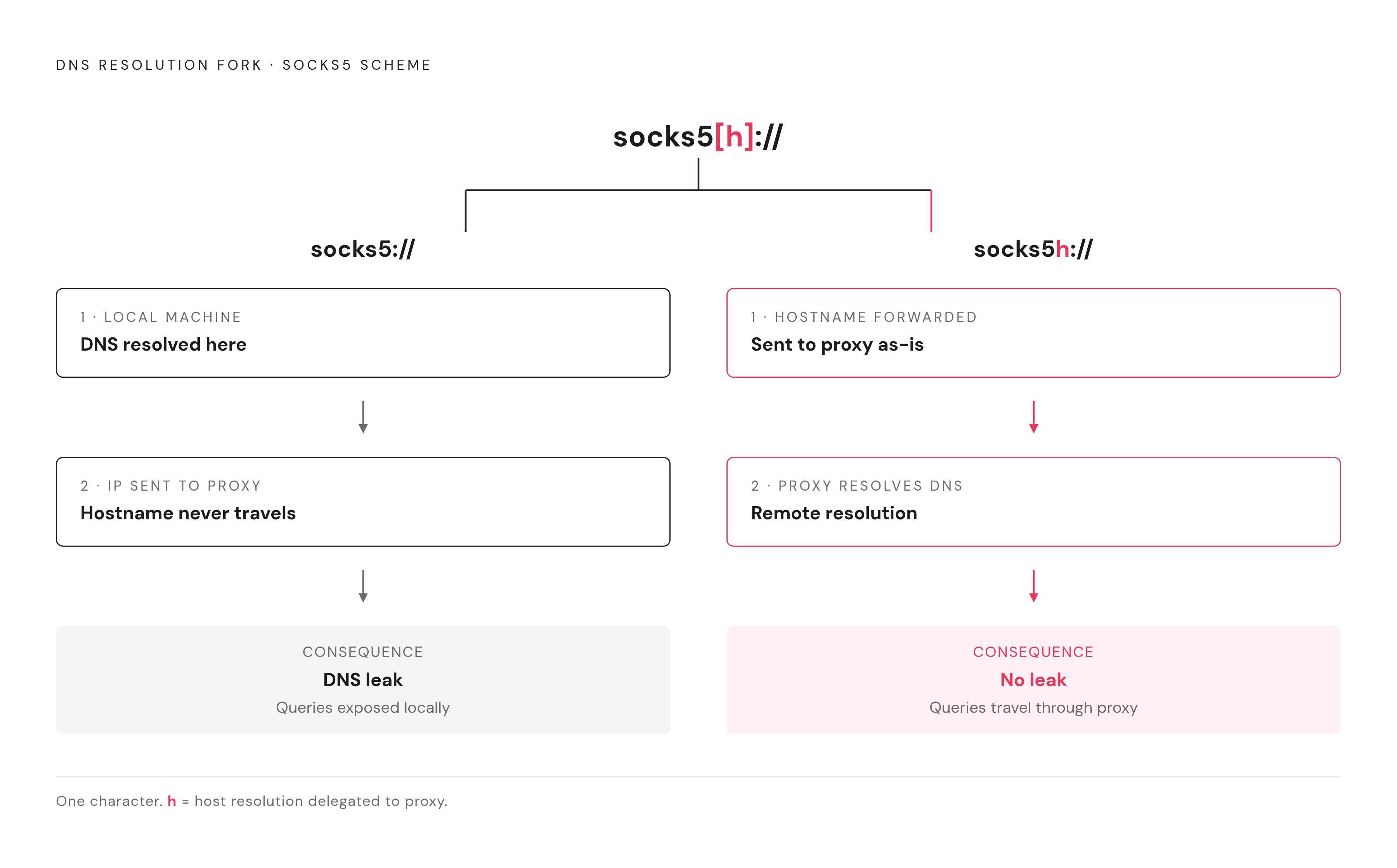
SOCKS5 can support remote DNS resolution, where the client hands the hostname itself to the proxy and the proxy performs the lookup on its own end, closer to the destination. But this only happens when the connection is configured to request it. The scheme a client uses makes the entire difference: socks5:// resolves DNS on the local machine, while socks5h:// resolves DNS through the proxy. One character separates two completely different DNS behaviors. Many clients default to socks5:// without the practitioner realizing it, so if you assume you're getting proxy-side DNS resolution, you may be leaking every DNS query to your local resolver instead, and that undermines the anonymity the proxy was meant to provide.
If hostname privacy matters, fix this for SOCKS5 by checking the scheme in use and switching to socks5h://. Fixing the equivalent exposure on the HTTP side is less direct: it requires running the client with system-wide DNS-over-HTTPS or DNS-over-TLS, or routing through a proxy balancer that handles resolution upstream on the client's behalf.
Protocol support beyond HTTP: where SOCKS5's session-layer position pays off
SOCKS5's ability to carry traffic beyond HTTP is the clearest capability gap between the two protocols, and it's architectural, so no clever configuration on the HTTP side can patch around it. SOCKS5 handles both TCP and UDP traffic. HTTP and HTTPS proxies are limited to web traffic by design.
UDP support matters concretely in collection workflows that depend on speed-sensitive, connectionless traffic, network telemetry, DNS lookups performed directly, or VoIP sessions. SOCKS5 supports all of these natively. An HTTP proxy, faced with the same traffic, either falls back to TCP in a way that degrades performance or rejects the connection outright, because UDP just isn't a traffic type the HTTP proxy model accounts for.
That same flexibility is why SOCKS5 fits cleanly into tooling built around mixed traffic, not just pure web requests. It plugs into LangChain, n8n, OpenClaw, and other AI-first frameworks, including MCP Server deployments and custom retrieval-augmented generation pipelines, as a single transport layer regardless of what kind of traffic each component generates. HTTP and HTTPS proxies, by contrast, can run into friction with WebSocket connections or streaming endpoints that don't map neatly onto a conventional request/response model. If a team builds an agentic AI pipeline where the traffic mix includes non-HTTP calls alongside standard web requests, a single SOCKS5 pool can cover the entire stack, so they don't need a separate proxy configuration for every traffic type the pipeline produces. As a general rule, SOCKS5 suits development tools, APIs, custom applications, and testing environments well, while HTTP and HTTPS remain the natural choice for web scraping and browser automation specifically.
How Playwright and Puppeteer implement each protocol, and the costs that surface in integration
None of SOCKS5's layer-level advantages arrive free of cost inside a headless browser. Both Playwright and Puppeteer impose their own framework-specific constraints, and those constraints decide which protocol you can actually use for a given workload, no matter which protocol looks better on architectural grounds.
Playwright supports HTTP, HTTPS, and SOCKS5 proxies natively, configurable either at browser launch or per BrowserContext, with the per-context setting serving as the mechanism most practitioners use for proxy rotation across sessions. But Playwright, running on Chromium, does not support username/password authentication over SOCKS5. Any workflow that depends on authenticated residential proxies has to use the HTTP or HTTPS endpoint instead; SOCKS5 remains usable only for IP-whitelisted access where no login credentials are required at the proxy level. It's a hard limit inherited from the underlying Chromium engine itself, independent of anything Playwright's maintainers or the framework could change on its own.
Puppeteer runs into a related but distinct problem. Its ERR_NO_SUPPORTED_PROXIES error occurs when you embed SOCKS5 credentials directly in the proxy URL, because Chrome does not support SOCKS5 username/password authentication, not just within Puppeteer's wrapper around it. The established workaround is the proxy-chain npm package, which stands up a local forwarding proxy, an anonymous local proxy that handles authentication with the upstream SOCKS5 endpoint on Puppeteer's behalf, so Chrome never has to negotiate SOCKS5 credentials itself. Complicating this further, the puppeteer-extra-plugin-stealth plugin that many developers relied on for combining SOCKS5 routing with stealth evasion is not actively maintained, leaving a widely used piece of the ecosystem's workaround stack effectively frozen in place.
For teams whose work is fundamentally browser-centered, QA passes, login testing, geo-validation checks, HTTP remains the safer first choice, simply because the authentication path and session management involve fewer adapters standing between the credentials and a working browser session.
Where each protocol fits in the headless browser detection landscape
Proxy protocol selection addresses exactly one layer of headless browser detection, and modern anti-bot systems have already moved the harder problems to layers that neither SOCKS5 nor HTTP can touch. Detection today operates across several distinct layers at once. API-level checks, such as inspecting navigator.webdriver, remain in use and are patchable, but they're also the easiest layer to defend against and the least interesting from an architectural standpoint. Rendering and GPU fingerprints are a harder layer to spoof, and proxy protocol has no bearing on them. Behavioral signals, mouse movement, timing, interaction patterns, are a layer no automation library has managed to replicate reliably at scale, and proxy protocol is irrelevant there as well.
Transport-layer fingerprints, TLS and HTTP/2 framing, are where protocol choice affects detection: SOCKS5's pass-through behavior preserves the browser's native TLS fingerprint and HTTP/2 framing instead of substituting the fingerprint of a proxy's own infrastructure. But that benefit comes with a qualification. Modern anti-bot platforms combine JavaScript environment analysis, hardware fingerprinting, network profiling, and behavioral signals into a single layered assessment. Protocol selection is one entry-level decision among the several a complete defense requires.
Even the TLS advantage carries a catch: because SOCKS5 passes the TLS handshake through untouched, it preserves the browser's native fingerprint, but the Chromium build used in many cloud-based headless deployments often lags behind the current stable release. That version gap creates a mismatch between the TLS fingerprint a server expects from a current browser and the one it actually receives, turning the fingerprint itself into a detectable signal regardless of which proxy protocol carried it. Headless mode on its own does not alter the TLS fingerprint when running the same Chromium version, so the exposure traces back to build currency, not to headless execution itself. If you get the protocol choice exactly right but run a stale Chromium build behind it, or ignore DNS coherence and behavioral realism, you remain exposed on every other layer the protocol was never meant to cover.
Matching proxy protocol to workload: a decision framework for automation practitioners
The right protocol follows from the actual traffic mix a workload generates, the toolchain it runs through, and the authentication constraints already in place, not from which protocol carries the stronger reputation in a given community. A workload that is fundamentally browser-centered, logins, account warm-up sequences, QA checks, geo-validation runs, or lightweight automation already built around HTTP proxy fields, tends to favor HTTP or HTTPS as the more practical default, since the surrounding tooling and error surfaces already assume that model. Teams that need authenticated residential proxies routed through Playwright face a more specific constraint: the framework's SOCKS5 authentication gap, inherited from Chromium rather than from Playwright itself, makes the HTTP or HTTPS endpoint the only practical option available for that particular combination. Fast debugging also favors the HTTP path for teams already fluent in it, since the familiar request model and its error surface, authentication failures, CONNECT-specific issues, ordinary status codes, align with knowledge most teams already carry, which shortens the distance between a configuration problem and a fix. And when you just need the shortest path from a set of credentials to a working, authenticated browser session with minimal adapters in between, HTTP remains the more direct route, even where SOCKS5 would otherwise offer structural advantages your workload doesn't end up needing.
Where the workload shifts away from a pure browser context, toward mixed TCP and UDP traffic, non-HTTP protocols, or infrastructure like LangChain and n8n pipelines handling several traffic types through one transport, SOCKS5's session-layer position becomes the more defensible choice, provided the practitioner accounts for its authentication limits in Playwright and Puppeteer in advance. Neither protocol functions as a universal answer. Each sits at a different point in the stack, and the workload in front of a practitioner, not convention, determines which point is the right one to occupy.
Methodology & sources
- DNS Resolution Through Proxies Explained
Provided the explanation of how socks5:// versus socks5h:// schemes determine whether DNS resolution happens locally or through the proxy.
- Browser
Informed the description of Playwright's proxy configuration options, including browser launch and per-BrowserContext settings.