GEO-Targeted Web Access for Localized Agent Data Collection
AI agents need local IP addresses to see the web as users in each market actually see it.
- Written by
- Priya Subramanian
- Published
- October 10, 2026
- Reading time
- 10 min read
What this covers
The web does not present one version of itself to the world. It presents a different version to every requester, keyed to where that requester appears to be standing, and that governs the accuracy of an AI agent's output. Search engines return different organic rankings, different local packs, and different ads, and that depends on the country and city a query comes from. E-commerce sites show different prices, different inventory, and different shipping terms by region. Some services geo-fence their content, so if you request from the wrong location you get nothing of value, or a page that looks complete but describes a different market. Even the structural furniture of a page, legal notices, cookie banners, default language, changes by jurisdiction.
If an agent checks prices, tracks search rankings, verifies ad delivery, or enriches sales leads from a datacenter IP in one country while its actual target is a different market, it does not collect localized data. It collects a distorted view of the web that happens to render cleanly and carries none of the local signal the task required.
Where geo-targeting enters the agent request stack
An AI agent stripped of its language model is just a browser issuing HTTP requests. The web's anti-bot defenses treat it the same way they treat any automated scraper, with no allowance made for what's generating the traffic. That mechanical reality makes geo-targeting an infrastructure problem.
The pipeline that carries an agent's task to a live web page has three layers, and any one of them can quietly break geo-accuracy. The third layer is parsing, typically an LLM converting messy, inconsistent HTML into structured output, and that layer can only work with what it's given. Fetch the page from the wrong geography and you get a clean, well-structured, entirely wrong record.
Anti-bot systems flag datacenter IP ranges fast, because the network and behavioral signals stand out and are easy to catalog. If you swap IPs mid-task, the session looks like account takeover to the target site, so you often get blocked, and the data set ends up internally inconsistent.
The legitimate use cases that depend on geo-accurate agent data
Geo-targeted collection is the operating condition for several mainstream business intelligence workflows, and each one fails in a specific, traceable way without it.
SEO rank tracking by country and city is the clearest example. If you check UK search rankings from a US-based IP, you get skewed, useless numbers, because the page an agent sees from a US address is not the page a UK user sees. Tracking international SEO performance requires emulating a local IP address in the market being measured, not approximating it from somewhere else.
Localized landing page and pricing testing depends on the same principle. A product page in Germany may quote a different price than the identical page served in France, so if an agent audits market-specific pricing or localization, it has to retrieve each page from within its own market to see what's actually there.
Lead enrichment through local search surfaces makes the workflow concrete. An agent discovers businesses in a target city through a local search surface, opens each business's detail page, reads the rendered fields (name, address, phone number, website, rating), and writes the enriched record into a CRM. Residential proxies located in the target geography make sure the agent sees the geo-scoped local results a real user in that city would see, not a globally averaged approximation that blurs the detail the workflow exists to capture.
What geo-targeted residential proxy infrastructure provides
Solving this problem for an agent fleet is not a matter of acquiring "a proxy." It requires maintaining geo-accurate, session-stable access at a concurrency level that a single human researcher with one exit node never has to think about, and that difference in scale changes what counts as adequate infrastructure.
Five functional requirements define whether an infrastructure provider actually fits agent workloads. Sticky sessions have to hold one IP for the full duration of a multi-step workflow, because rotating mid-task reads as account takeover and gets the session blocked, so the sticky session duration a provider offers has to match the longest workflow the agent actually runs.
Concurrency headroom is the requirement that most clearly separates agent infrastructure from traditional scraping infrastructure. A human researcher runs one browser session at a time. Pool quality and ethical sourcing round out the list: a pool full of pre-flagged or previously abused IPs produces higher failure rates on every fetch, while a cleaner, more defensibly sourced pool produces better extraction success rates simply because its IPs haven't already been blocked by the sites being targeted. Protocol support, HTTP, HTTPS, SOCKS5, has to match whatever scraper framework or browser client the agent runs on, because a mismatch at that layer breaks the integration no matter how good the underlying pool is.
How leading proxy providers serve geo-targeted agent collection
The providers serving this market differ in ways that matter for specific workload types, and the right choice depends on which of the five requirements above carries the most weight for a given task.
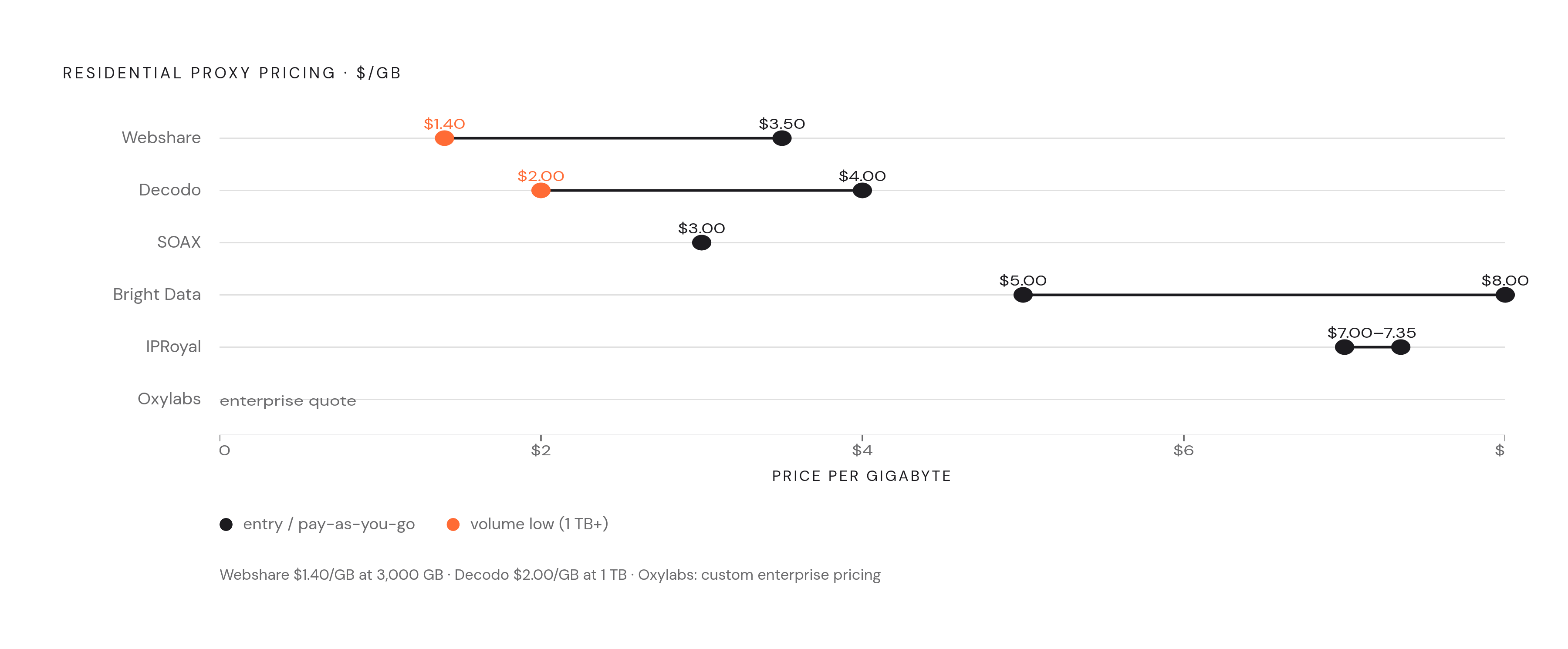
Bright Data positions toward enterprise and agent-native workloads. Its residential pool runs over 400 million IPs, and it can geo-target down to ZIP code, carrier, and ASN. Its agent-oriented product layer goes beyond raw proxy access: the Web MCP Server, with a free tier of 5,000 requests per month, exposes web search across Google, Bing, and Yandex as structured data and offers page scraping of any URL as Markdown or HTML with bot detection handled server-side. Its Browser API is priced from roughly $5 to $8 per gigabyte on a pay-as-you-go basis and gives you AI-friendly cloud browsers, and Deep Lookup is a pay-per-result research API.
Oxylabs focuses on enterprise Playwright and MCP integration. Its residential pool exceeds 175 million IPs across 195 countries, and you get country and city targeting. OxyCopilot comes built into the Web Scraper API at no added charge, so you can generate request code and parsing templates from plain-language descriptions instead of building a geo-targeted collection pipeline from scratch.
Decodo is mid-market priced, roughly $4 per gigabyte on a pay-as-you-go basis, dropping to about $2.75 per gigabyte at 100 gigabytes of volume and to roughly $2 per gigabyte only at the 1-terabyte Enterprise tier, placing it between budget and enterprise offerings.
SOAX offers a residential and mobile mix with carrier-level targeting: country, region, city, ISP, and ASN targeting, sticky sessions running up to 60 minutes, and carrier IPs for mobile-web collection where content differs by network. Its Builder plan prices Tier 1 access at $3.00 per gigabyte, and you can test first with a free Sandbox option.
DataImpulse markets an ethically sourced residential and mobile pool of more than 90 million IPs across 195 countries, with country, city, and ASN targeting, and its budget positioning suits evaluations where concurrency volume is high and per-gigabyte cost is the binding constraint.
IPRoyal offers country, state, and city targeting alongside sticky sessions that run up to 7 days, the longest duration among the providers covered here, suited to workflows that need to hold one identity across extended collection cycles. Pricing runs from roughly $7.00 per gigabyte on subscription or about $7.35 per gigabyte pay-as-you-go.
Webshare offers a free tier alongside datacenter and residential IPs with country targeting, priced from about $3.50 per gigabyte at the 1-gigabyte tier (half of its standard $7.00 rate), dropping to roughly $1.40 per gigabyte at 3,000 gigabytes of volume.
MCP and geo-targeted agent integration
The Model Context Protocol has become the layer connecting AI agents to external tools, data sources, and services, and it is changing geo-targeting from a scraping engineering task, custom HTTP client configuration, proxy rotation logic, session management code, into a typed tool surface an agent can call directly.
Instead of writing proxy rotation and geo-header logic into the agent's own code, you just call a tool exposed by an MCP server, and the infrastructure complexity moves off the developer's desk and onto the server. A 2026 guide from Scrapeless frames this shift as "agent-native beats glue code," arguing that a cloud browser paired with an MCP server gives the agent a typed tool surface where geo and session parameters are first-class arguments rather than afterthoughts patched in at the HTTP layer. Bright Data's Web MCP Server puts this into practice: it exposes web search and page scraping to LLMs and agents directly, handles bot detection server-side, and turns geo-targeting into a parameter you pass in a tool call rather than a proxy configuration you maintain separately. Oxylabs's MCP integration connects Playwright directly to residential-proxy-backed remote headless browsers, so the agent framework gets geo-accurate rendering without managing the browser or the proxy infrastructure underneath it.
As MCP adoption spreads, the teams that produce the most accurate localized data will be the ones running on the strongest underlying proxy infrastructure. The integration layer removes the engineering friction that used to limit who could run geo-targeted collection at scale, so once that friction is gone, the quality of the proxy pool behind the tool call is the only variable left that separates accurate output from distorted output.
The legal and compliance framework governing geo-targeted agent collection
Jurisdiction-awareness is part of the infrastructure itself, not a separate legal afterthought.
US case law has moved in a fairly consistent direction on public-data collection, though not without open questions. Even platforms with substantial legal resources have not succeeded in using the CFAA to stop scraping of their public data under this body of precedent.
Geography adds its own layer of exposure on top of this. The UK's Data Protection Act, California's CCPA, and Canada's PIPEDA each layer on their own jurisdiction-specific requirements, and geo-targeted collection triggers them by definition: an agent pulling data from UK IPs is collecting under UK rules regardless of where the operator sits.
Enforcement is also happening outside the courts.
Turning these overlapping requirements into something operational means building compliance into the pipeline itself. A robots.txt parser tied to a CI gate can prevent collection from disallowed paths before a deployment ever runs. Per-jurisdiction policy bundles can encode the applicable rules for each market an agent targets, and a provenance ledger, a record of what was collected, from where, under which rules, gives legal counsel something concrete to audit.
The ethical sourcing question and the session-continuity objection
Two objections challenge the legitimacy of geo-targeted residential proxy collection, and both deserve direct engagement rather than a quick dismissal: whether the IP pool is actually ethically sourced, and whether sticky sessions used in multi-step agent workflows cross from data collection into impersonation.
On sourcing, most residential proxy pools depend on end-user devices enrolled in peer-to-peer networks, so ordinary consumers' home IP addresses and spare bandwidth get monetized as someone else's collection infrastructure. So you should treat pool quality as a buying criterion for ethical reasons as much as for performance reasons: when a pool is built on clear opt-in consent, it tends to carry fewer pre-flagged IPs and so degrades collection performance less often than a pool with murkier origins.
On session continuity, agents running multi-step workflows, searching, navigating, comparing, recording, hold one consistent IP identity across each of those steps through sticky sessions, and critics argue this mimics real human account behavior closely enough to move past passive collection and into something closer to impersonation. The distinction that matters runs along the use case itself. Responsible infrastructure frameworks draw that line by design: they treat geo-targeted sticky sessions for public data collection as in scope, and authenticated access to account-gated content as out of scope.
Building a geo-targeted agent data pipeline that reflects ground truth
Getting localized agent data right is an architecture decision, not a single tool purchase, because the geographic accuracy of the final output depends on choices you make at every layer of the pipeline, not just the proxy layer alone.
The practical stack starts with a browser or managed API layer, a headless instance of Playwright or Chromium, or a cloud browser from a provider with proxy infrastructure built in, handling the JavaScript rendering that prices, availability figures, and search results depend on. Where the agent framework supports it, an MCP server or scraper API manages geo and session parameters at the tool-call level instead of inside the agent's own code, shrinking the surface area where misconfiguration can appear. The LLM parsing layer converts the rendered HTML into structured JSON or Markdown, and its accuracy is bounded entirely by the quality of the page it receives; that is why the geo and rendering layers come first and aren't optional extras bolted on afterward.
Matching infrastructure to workload follows from the same logic. Enterprise workloads facing anti-bot-defended targets and real compliance requirements should prioritize pool size, unblocking capability, MCP integration, and documented ethical sourcing, the territory Bright Data and Oxylabs occupy. Long multi-step workflows need a sticky session duration that matches the workflow itself, whether that means IPRoyal's 7-day maximum or SOAX's 60-minute window. And before any of this gets committed to in production, a free tier, Webshare's or Bright Data's MCP tier at 5,000 requests per month, lets a team validate the pipeline against real target sites while the cost of being wrong is still small.
An AI agent's output is only as accurate as the web it was shown, and the web it was shown is set entirely by the geographic identity of its requests. Geo-targeted residential proxy infrastructure is the condition that makes localized agent data possible, deciding whether what the agent reports back matches what a real person in that market would actually find.