Browser Automation Detection by Major Platforms
Why major platforms layer bot detection across TLS, browsers, behavior, and challenges.
Bot traffic is now a structural fact of how the internet works. Bot traffic has already surpassed human traffic, a structural shift that explains why platforms built layered detection systems instead of relying on one filter. The stakes on both sides got too big for a single checkpoint to handle.
None of this detection is arbitrary. Platforms are protecting ad revenue, proprietary data, and the basic experience of users who don't want to compete with scripts for inventory or attention. For GTM and RevOps teams, six months of stable automation can give way to failure that never throws an error. No warning, just bad data creeping into the pipeline, enrichment records going stale, and nobody noticing until a forecast falls apart. Most teams still treat this as a proxy problem: buy more IPs, rotate them faster, call it solved. That's the wrong read, and the five layers below explain why.
Layer 1: TLS and network fingerprinting: the detection that happens before JavaScript loads
Before a single pixel renders, before any JavaScript runs, the TLS handshake has already said a lot. The ClientHello message, the first thing a client sends when opening an HTTPS connection, carries the list of supported cipher suites in preference order, the TLS extensions and their order, supported groups, signature algorithms, and ALPN protocols. That's a fingerprint, and it exists before the browser environment even loads.
For years the standard way to hash this fingerprint was JA3. Then Chrome, starting in 2023, began randomizing the order of TLS extensions, which broke JA3's reliability. JA4 came in as the fix, producing a stable fingerprint regardless of the order in which the wire sends things. JA4 identifies the TLS library doing the talking, separate from whatever the User-Agent string claims.
That's why spoofing a User-Agent solves nothing on its own. Sending a Chrome User-Agent header through a Go HTTP client or a Python requests session gives away the JA4 fingerprint immediately, because Go and Python run entirely different TLS stacks than actual Chrome. HTTP/2 SETTINGS frame order and TCP window size add more texture to the same fingerprint, compounding the mismatch. Akamai, like Cloudflare, treats TLS fingerprinting as a primary signal rather than a backup check. None of this can be patched around client-side: it happens entirely on the server, before a browser environment or a JavaScript engine ever gets involved.
Layer 2: Browser environment interrogation: what headless sessions reveal about themselves
Once a connection opens, the browser itself becomes the next witness. WebGL fingerprinting reads how a GPU actually renders graphics, a hardware behavior, not a software property some script can swap out on command. Nobody rotates a graphics card the way they rotate a residential IP, and anti-bot vendors lean on WebGL for exactly that reason: it stays stable in a way most other signals don't.
AudioContext fingerprinting works on a similar principle, though it carries less entropy than WebGL. It depends on the actual audio processing pipeline running underneath the browser, and headless environments often have no audio stack at all, or a software stand-in that matches no real desktop machine anywhere. Canvas fingerprinting and font enumeration round out the remaining high-entropy signals still standing after Google's Privacy Sandbox changes took effect.
Privacy Sandbox froze the User-Agent string, hardcoded navigator.plugins to a fixed list, and cut down the entropy available through Client Hints. It changed nothing about canvas rendering, WebGL behavior, AudioContext output, or TLS handshake characteristics. Vendors noticed the navigator-based signals getting gutted and simply moved detection down to the hardware layer instead. A session claiming to be Chrome on Windows, while its audio stack and WebGL renderer match a headless Linux box, throws a coherence mismatch that's trivial to catch. Research on the topic has linked WebGL fingerprinting mismatches to a significant share of unexplained 403 errors.
Layer 3: Behavioral analysis and ML scoring: how platforms distinguish humans from well-disguised scripts
DataDome scores every request starting with the very first one, using signatures and reputation data, then layers behavioral analysis on top as the session continues, rather than waiting to escalate only after suspicion builds. That's a different bet than Cloudflare or Akamai makes, and it means there's no grace period during which a bot session flies under the radar by default.
DataDome reportedly runs more than 85,000 customer-specific machine learning models, so every protected site is its own separate detection puzzle rather than one shared baseline to reverse-engineer. The platform collects over 35 signals per session: mouse movement patterns, scroll velocity, typing cadence, click coordinates, focus and blur timing. Starting in 2025, it added intent-based detection on top, comparing a session's navigation flow against the known usage patterns of that specific site rather than judging isolated signals in a vacuum.
A session can nail every fingerprint check and still get flagged if it loads pages at inhuman speed or never moves the mouse once. Identical timing between requests, zero scroll events on pages where a human would obviously scroll, no focus or blur transitions at all, navigation sequences no real user would ever take: these push a bot score up. By 2026, detection systems had grown sophisticated enough that a clean session in isolation carries less weight than the full pattern of behavior surrounding it. A CF-RAY header points to Cloudflare, an _abck cookie points to Akamai, and a bare 429 response with no body points to Kasada, giving quick identification shorthand to anyone who knows to look.
Layer 4: Active challenges and CAPTCHA evolution: from visual puzzles to invisible scoring
Cloudflare Turnstile mostly skips the visual puzzle altogether, running non-interactive browser challenges quietly in the background. Its default Managed mode can still throw a checkbox at higher-risk visitors, but a fully invisible mode exists too. Google's reCAPTCHA v3 goes further, assigning a risk score for the session rather than presenting a visual puzzle. The image grids, slider puzzles, and 3D rotation challenges people associate with CAPTCHAs are now reserved for the worst-scoring sessions only, an escalation path rather than a default gate.
FlareSolverr, the open-source tool many people reach for to solve Turnstile challenges, recorded a 0% pass rate against Cloudflare Enterprise targets in tests run in April 2026. That decline was already visible through 2025, and by 2026 the tool simply isn't viable in production against Cloudflare's stronger tier. Kasada sits at the far end of this spectrum, combining active environment interrogation with per-site challenge rotation in ways that make DIY bypass attempts particularly difficult to sustain.
The mental model has to shift. The challenge layer used to be a gate: solve it once, get through. Now it's a continuous scoring process running the whole session, with no single obstacle left to defeat and move past.
Layer 5: IP and proxy reputation: what rotating IPs solve, and what they don't
Proxies are genuinely useful for exactly one job: fixing IP reputation, getting past ASN blocklists, and matching geolocation expectations. That's the whole job. Proxies do nothing for a TLS fingerprint, nothing for HTTP/2 behavior, nothing for browser rendering artifacts, and nothing for how a mouse moves across a page.
The gap between datacenter and residential IPs is stark. Internal tests run across three commerce sites found residential IP rotation succeeding on 96.4% of requests, against just 34.1% for datacenter IPs, with every other variable held constant. Bright Data's network, drawing on a large pool of residential IPs spread across 195 countries, shows how much infrastructure this one layer demands on its own. Datacenter IP ranges are far easier to block in bulk than residential IPs, which share address space with ordinary home internet users.
Spending budget on residential proxy rotation while leaving a mismatched TLS fingerprint or a robotic mouse pattern untouched wastes most of that money. The 34.1% figure illustrates how sharply a mismatched fingerprint can limit success rates regardless of IP quality, and proxy spend alone cannot address that gap.
How evasion tools have responded to layered detection
The evasion side of this arms race splits into three broad categories, and each one solves a different slice of the problem while leaving another slice exposed.
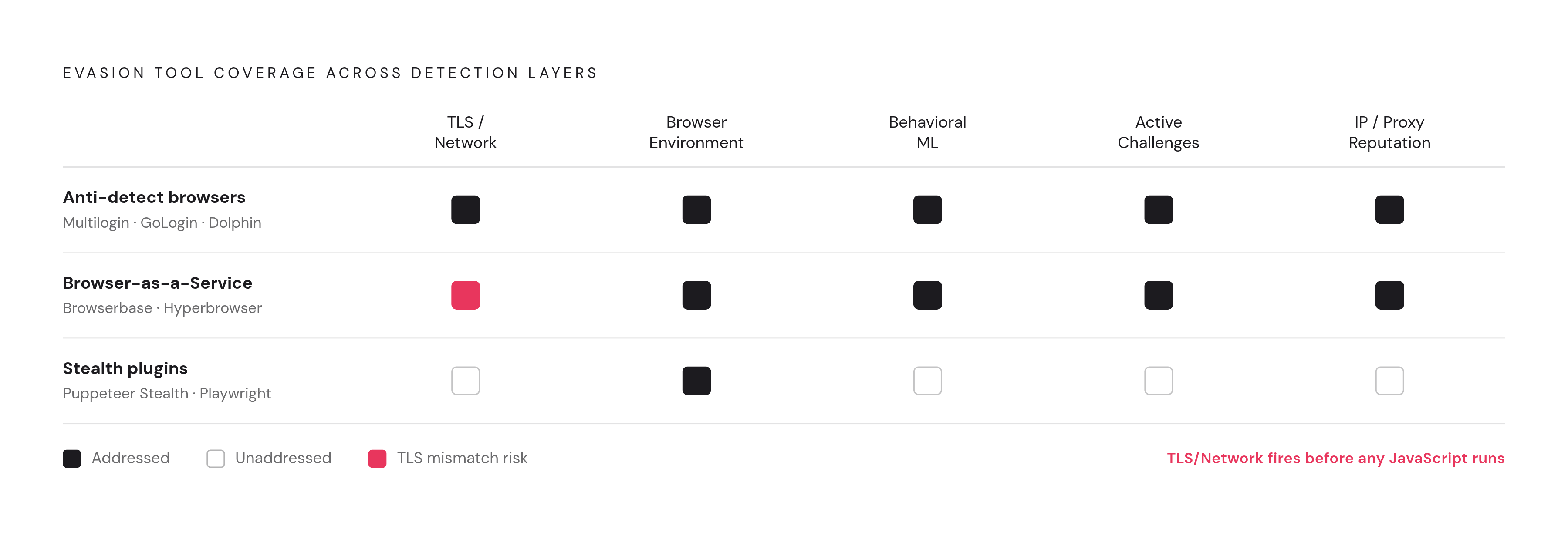
Anti-detect browsers like Multilogin, GoLogin, and Dolphin Anty run modified versions of real browser engines instead of automation frameworks bolted onto a browser. They're the hardest category to catch precisely because no single signal gives them away, which forces detection systems to rely on ensemble methods that weigh several signals together. Browser-as-a-Service platforms such as Browserbase and Hyperbrowser run genuine Chromium instances in the cloud, so the JavaScript-level fingerprint is authentic. Their weak point can be at the network layer, where the underlying Chromium build may not perfectly match what the claimed browser version would produce at the TLS level. Stealth plugins like Puppeteer Extra Stealth and Playwright's stealth add-ons patch navigator.webdriver, spoof plugin arrays, and override Chrome runtime properties, with newer versions faking WEBGL_debug_renderer_info too. None of that touches TLS or anything at the network layer.
Camoufox, a Firefox-based tool (version 146.0.1-beta.25 as of January 2026), takes a different approach entirely: it modifies the browser at a deeper level instead of patching things through JavaScript after the fact. Its modifications are applied before any JavaScript executes, making them invisible to JS-layer detection scripts. Its approach is designed to be invisible to JavaScript-layer detection scripts that would otherwise catch such modifications.
The math on combining fixes tells its own story. Fixing WebGL alone produces only partial improvement, since other layers of detection remain active. Stacking WebGL fixes together with TLS correction, residential proxies, and realistic timing patterns is necessary to meaningfully reduce the block rate. Consistency across every layer is what actually matters, full stop. A Chrome User-Agent paired with a Python TLS fingerprint gets caught by every major vendor, no matter how convincing the rest of the setup looks. Even the best evasion stacks need constant upkeep, since challenge rotations and fingerprint databases don't sit still.
Cloudflare's Web Bot Auth protocol and the structural shift to cryptographic identity for AI agents
Cloudflare proposed something structurally different in May 2025: Web Bot Auth, a system built on HTTP Message Signatures using Ed25519 public key cryptography, with verification keys published at a well-known JWKS directory. It shipped into the Verified Bots Program on July 1, 2025, the same day Cloudflare started blocking AI crawlers by default and opened a pay-per-crawl beta. An IETF specification for Web Bot Auth followed in May 2026, still an active working-group Internet-Draft at that point. Then on June 2, 2026, Cloudflare rolled out a Bot Management update creating a distinct "Verified AI Agent" category, built on the W3C spec, using cryptographic identity rather than inferred behavior.
Adoption spread fast beyond Cloudflare too. Vercel added support in August 2025, Stytch and Akamai followed the next month, AWS WAF Bot Control added it in November 2025, and Shopify came on board as well. Visa worked with Cloudflare on a Trusted Agent Protocol aimed squarely at agentic commerce payments. Given that Cloudflare handles something like 20% of all HTTP traffic, this counts as the largest edge-level deployment this protocol has seen.
Formal standardization lagged behind actual deployment, and that gap tells you something about how this industry actually moves. As of August 12, 2026, the IETF working group had no adopted documents, only individual drafts, and adoption didn't happen until September 1, 2026. Cloudflare, AWS WAF, Akamai, HUMAN, and Vercel were already verifying signatures in production well before that date. With Cloudflare, Anthropic, and OpenAI moving to production together, the protocol became a de facto standard before it was ever formally ratified.
Identity is now provable instead of inferred, and that shift produces everything downstream. A verified agent doesn't need to evade anything, because it's authenticated at the protocol level, and permission itself has become something a platform can sell, hence pay-per-crawl. Robots.txt is fading out in parallel: a Duke University study found entire categories of AI crawlers that never request robots.txt at all, and OpenAI has removed language committing its ChatGPT-User crawler to honoring it, on the position that user-initiated agent actions simply aren't covered by that convention.
LinkedIn's specific detection upgrades
LinkedIn sits at the exact point where browser automation detection collides head-on with B2B pipeline generation, and the collision has real teeth. Its 2026 detection upgrades zero in on headless browser identification and spoofed user agents, on mismatches between the declared browser environment and actual behavior (a session claiming Chrome on Windows while behaving like headless Chromium on Linux), and on request velocity: how fast a session jumps between profiles, how quickly it goes from viewing a profile to sending a connection request, how fast it replies to messages.
That velocity check isn't measured against some universal clock. LinkedIn scores it against the account's own history, so a sudden spike from a normally slow-moving profile reads as suspicious even at a pace that would look ordinary coming from someone else's account.
The stakes here run higher than on most other platforms, for a simple reason. Losing access to a scraping target elsewhere is an inconvenience. Losing a LinkedIn account means losing a rep's entire prospecting surface, and unlike an IP address, an account can't be rotated out for a fresh one. LinkedIn also holds an advantage most platforms don't: it can correlate session-level behavioral signals directly against the authenticated identity of the account holder, so there's no anonymity layer to hide behind the way there might be on an open web target. The real risk for a sales team is a restricted or permanently banned account, and that cuts off the rep's whole network along with every deal sitting inside it.
What layered detection means for sourcing and enriching B2B data
Taken together, the five layers turn automation that ignores platform detection architecture into a liability sitting quietly in the CRM until it blows up a forecast. A scraper that fails silently just stops returning fresh data, enrichment records go stale, and nobody notices until the pipeline numbers stop making sense. It just stops returning fresh data, enrichment records go stale, and nobody notices until the pipeline numbers stop making sense.
Fixing this means consistency across every layer at once: a TLS fingerprint that matches the claimed browser, a WebGL and AudioContext profile that matches the claimed operating system, mouse and scroll behavior that looks like an actual person, and IP quality suited to the platform being touched. Fixing one layer while ignoring the rest barely moves the needle, and the research bears that out directly: fixing WebGL alone still leaves most requests blocked.
Diligence on a data or automation vendor shouldn't start and end with "do you use residential proxies." That question alone misses almost everything that matters. It should examine whether the vendor's architecture accounts for all five layers together, and whether it adapts as platforms roll out new challenge versions and fingerprint databases, since none of these fixes have a long shelf life. Detection engineering is an ongoing negotiation between platforms protecting their data and teams that need reliable access to it, and the teams that treat platform constraints as a design input, rather than an obstacle to route around, are the ones whose pipeline data still holds up under scrutiny six months from now.
Sources
- Top 9 Browser Automation Tools for Web Testing and Scraping in 2026
- Top 7 Browser Automation Tools in 2026
- en.wikipedia.org
- TLS fingerprinting in 2026: what the ClientHello reveals (and where the signal fails)
- TLS Fingerprinting: How It Works & How to Bypass It (2025)
- When Handshakes Tell the Truth: Detecting Web Bad Bots via TLS Fingerprints
- blog.send.win
- cside.com