Canvas and WebGL Fingerprinting in Headless Browsers
Hardware rendering differences reveal headless browsers despite software-layer evasion attempts.

- Written by
- Danielle Osei-Bonsu
- Published
- October 6, 2026
- Reading time
- 11 min read
What this covers
Canvas and WebGL fingerprinting work by reading how a machine's actual hardware renders graphics, not by reading a value the browser agrees to hand over. That distinction is the whole subject of this piece: why headless browsers struggle against it, and what it takes to close the gap.
Canvas and WebGL fingerprinting at the rendering layer
Canvas fingerprinting starts with a script drawing a hidden scene onto an HTML5 canvas element: some combination of text strings, geometric shapes, and overlapping colors that never appears on screen. The script then calls toDataURL() or getImageData() to pull the resulting pixel array back out and hash it. Nothing about that process touches a cookie or a header. The pixel values that come back depend on the GPU model doing the rendering, the driver sitting between the GPU and the operating system, the OS's own text-rendering pipeline, how fonts get rasterized on that particular machine, and which anti-aliasing strategy the rendering stack applies. Two computers can run the identical browser version on the identical operating system and still produce two different canvas hashes, because the divergence happens below the browser, in hardware and drivers the browser doesn't control. That makes the signal independent of things like screen resolution or installed fonts list, which a script can also read but which don't depend on how pixels get drawn.
WebGL fingerprinting works on a parallel track, pulling from parameters that only make sense at the hardware level. UNMASKED_RENDERER_WEBGL reports the actual GPU string. The browser also exposes the full list of supported WebGL extensions, numeric precision values for shader calculations, and the maximum texture size the hardware can handle. All of these vary by GPU and driver combination, and the combination of answers forms a profile that's much harder to fake convincingly than any single value on its own.
The 2022 DrawnApart research pushed this further by showing that fingerprinting doesn't stop at the level of GPU model. Manufacturing produces small, physical differences between individual units of the same nominal GPU model, and those differences show up as measurable timing variation during rendering. DrawnApart's authors describe the technique as non-deterministic, built on timing measurements rather than the deterministic pixel hashes of classic canvas fingerprinting, and they showed the resulting fingerprints stay stable enough to track a single device across more than 130 days. Two GPUs that are, on paper, identical can be told apart, and that device stays identifiable for months. That's the foundation everything else in this piece depends on: the signal lives in hardware and manufacturing variance that a piece of software can't simply declare its way around. Environments without real hardware underneath them run into trouble as a result.
Why headless environments are structurally exposed, not just misconfigured
Headless browsers running inside containers almost never have a physical GPU to talk to. Docker containers, AWS Lambda functions, and most CI runners hand the browser a software renderer instead, and that substitution shows up directly in the fingerprint. When standard headless Chromium draws a canvas element or sets up a WebGL context, the output reflects whichever software rendering path handled it, Google SwiftShader on most platforms or Mesa's llvmpipe on Linux, a software fingerprint distinct from any real GPU's behavior.
SwiftShader and llvmpipe both render WebGL entirely on the CPU, and the entire capability surface they report, extension lists, precision values, texture limits, differs from what any real GPU reports. That full surface can be checked against whatever renderer string the session claims, and a mismatch there is easy to catch. A containerized runner's software renderer isn't a setting someone forgot to flip. A real consumer laptop, even a cheap one with integrated graphics instead of a discrete GPU, still exposes a hardware-accelerated rendering path. A containerized runner almost never does. The software renderer is the default condition of the entire category of environment headless automation runs in.
Chrome's own roadmap adds a complication that's worth tracking closely. Chrome has deprecated automatic fallback to SwiftShader-backed WebGL, a change noted in DevTools starting with Chrome 130. For real users, this closes off a software-rendering fallback you could previously count on by default. For headless workflows that depended on that same fallback to get a working WebGL context at all, the practical effect is that context creation will start failing outright instead of silently falling back to a slower, CPU-bound renderer. The same change that removes a detection signal for ordinary users breaks a dependency that headless automation was quietly relying on.
Cross-Signal Incoherence as a Detection System
None of this works as a single pass-fail check. Anti-bot systems score consistency across every layer of a connection and a session, so if a realistic User-Agent string is paired with a TLS handshake that no real browser produces, that's already a red flag before rendering even enters the picture. The same logic runs inside the rendering layer itself. A session claiming to be Chrome on Windows, while WebGL reports SwiftShader as its renderer, or while the TLS fingerprint matches a stripped-down headless Linux build, produces a contradiction no genuine browser session generates. That mismatch, not any single value, is what gets flagged.
The contradiction can live entirely inside WebGL's own parameter set, too. If a renderer string claims to be an Intel UHD 620 but its extension list, precision values, and texture limits match software rendering instead of that chip's actual profile, detection systems catch an internal inconsistency with no need to cross-reference other layers. Canvas and WebGL results are rarely scored in isolation. Canvas output usually feeds into a wider composite profile, so if it disagrees with other collected signals, it raises the session's overall risk score and factors into the broader evaluation alongside other flags.
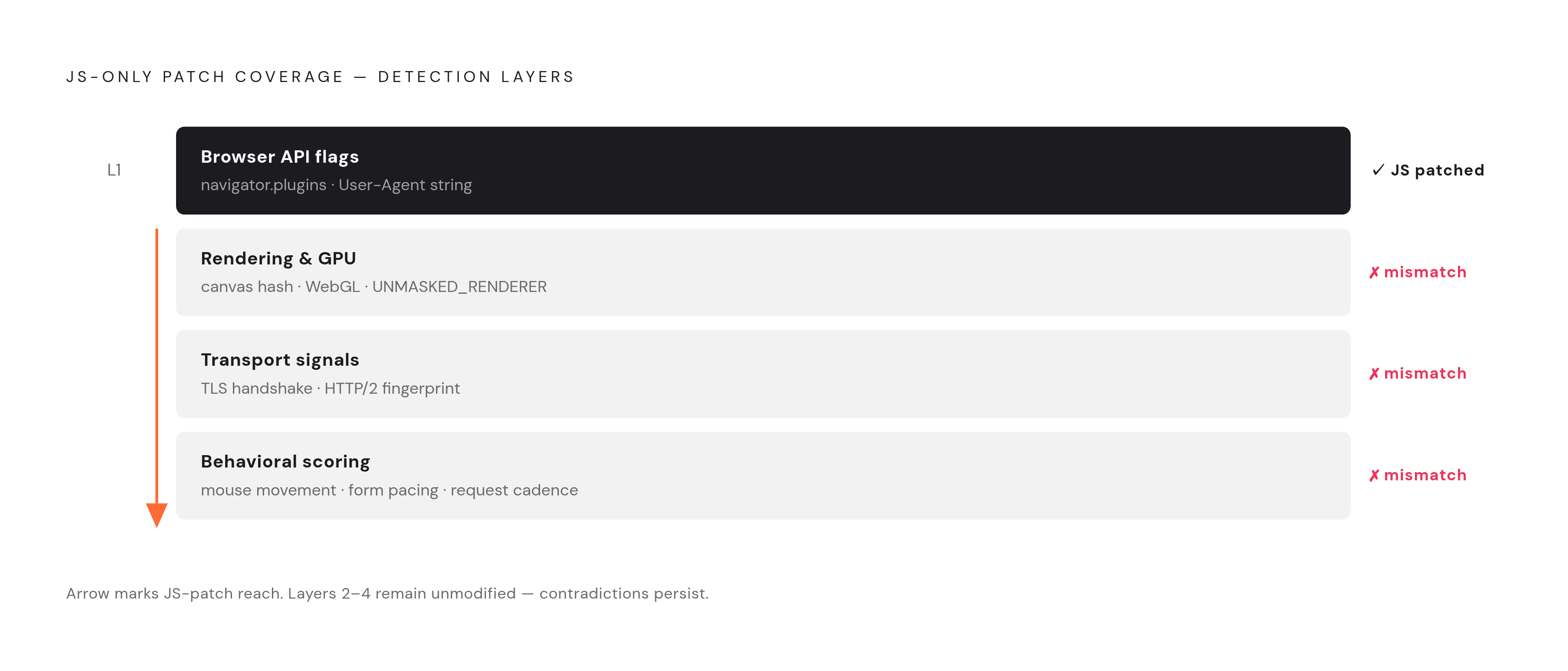
Ordering matters here. Rendering and GPU fingerprints make up Layer 2 of a detection stack, harder to patch convincingly than the browser API flags that make up Layer 1, and above transport-level signals at Layer 3 and behavioral scoring at Layer 4. Each of these layers operates independently of the others. Patching one layer cleanly doesn't repair a contradiction that a different, untouched layer is still producing, which is the central reason single-point fixes keep failing against systems built to check for agreement across the whole stack.
Where JavaScript-layer evasion falls short
The first tier of evasion tools works by intercepting API calls at the JavaScript layer, changing what gets handed back to a script without touching what the rendering engine actually produces underneath. The typical approach injects JavaScript during a page's initialization phase, before any fingerprinting script can run, and overrides the Canvas API and WebGL context objects directly. From there, the patch can spoof the GPU vendor string a script reads and add noise to whatever pixel data comes out of an image extraction call.
Spoofing UNMASKED_RENDERER_WEBGL alone is simple: it's one string, read once. Keeping the rest of WebGL's reported surface consistent with that spoofed string is a much bigger job, because the extension list, the precision values, and the max texture size all still reflect whatever the real underlying renderer is unless each one gets patched to match the fake identity too. Missing one leaves the renderer string disagreeing with everything around it. Canvas noise injection runs into a parallel problem. Adding cryptographic noise to a pixel extraction does break a simple hash match, but noise applied consistently across sessions becomes its own identifiable pattern, and noise applied per call creates a different failure: a site that hashes the same canvas twice within one session gets two different results back, something no real, unmodified browser ever produces.
These patches age fast because detection vendors keep adding new cross-checks that frozen code can't cover. The playwright-extra stealth plugin hasn't had a meaningful update since March 2023. Detection vendors keep adding new cross-checks, and a patch frozen at a point in time has no way to cover checks introduced after that point. JS-layer interception has a structural ceiling: it can only ever answer the checks its authors knew about when they wrote it, while the underlying render it's trying to disguise keeps producing the same giveaway output it always did.
What engine-level spoofing achieves that JS interception cannot
A more thorough class of evasion tooling patches fingerprint values inside the browser's own compiled code, at the C++ layer, rather than overriding values after the fact in JavaScript. Because the change happens below the JS surface, any inspection that bypasses JavaScript entirely still sees values that look native to the engine.
Camoufox is one example of this approach: an open-source Firefox build that patches navigator properties, screen data, WebGL parameters, font metrics, audio output, and geolocation directly inside Firefox's C++ code, distributed with a Python library that speaks the standard Playwright API. In a September 2026 benchmark run by ScrapingBee, Camoufox scored 0% on CreepJS's headless detection check, while stock Playwright running Firefox failed at a significant rate and stock Playwright running Chromium was caught every time. That result came with a real cost: Camoufox uses over 200MB of memory per browser context and takes substantially longer to clear a Cloudflare Turnstile challenge on average than simpler tools, running as version 0.5.6 at the time of that benchmark.
nodriver takes a different route to the same problem. It speaks directly to the browser's own low-level automation protocol with no WebDriver layer and no higher-level wrapper on top, so it skips the automatic Runtime.enable call sequence that fires at startup under most automation frameworks, a sequence detection systems commonly read as an automation tell (a user's own code can still issue that same call explicitly later, which reopens the same tell manually). In a May 2026 test across 31 live, Cloudflare-protected targets, nodriver came back with 28 sessions scored OK, 3 gated, and zero hard blocks, the only tool in that comparison that didn't trigger a single hard block.
The advantage both tools share over JS-layer interception is straightforward: values patched into the compiled engine look identical to a real browser's values to anything inspecting them from JavaScript, because there's no override sitting on top of the real value for an inspection script to find. What neither tool touches is behavior. Engine-level patching changes what the browser reports about itself. It says nothing about how a script moves a mouse, how fast it fills a form, or how it paces requests, and that whole category of behavioral detection sits entirely outside what rendering-layer spoofing, at any tier, can reach. Teams that would rather not build and maintain this kind of patching in-house can use a managed alternative offered by other vendors, one of which describes its own job as keeping fingerprint coherence intact across browser execution, TLS, HTTP/2, and proxy geography all at once, patching every layer together.
Where the software-renderer signal produces false positives
The strongest objection to all of this detection logic is that software renderers appear on real, legitimate systems too, and it's a fair objection. Enterprise VMs without GPU passthrough, CI pipelines running automated tests, accessibility testing setups, and remote desktop sessions all can produce software-rendered output through no attempt at concealment whatsoever. An SVGA3D or virgl renderer string can point to paravirtualized graphics inside an enterprise VM. llvmpipe appears constantly in GPU-less CI runners used for accessibility checks and screenshot regression testing. Remote desktop sessions can expose a software rendering path for reasons that have nothing to do with bot activity.
Chrome's own team has acknowledged this tension directly. The proposal to remove SwiftShader as an automatic WebGL fallback explicitly carves out a separate path for web developers through a Chrome flag, rather than closing the fallback off entirely, which only makes sense if the signal is understood to have legitimate uses sitting alongside its bot-associated ones. WebGL being unavailable at all doesn't prove a session is automated, and a software renderer string by itself doesn't either.
What resolves the tension is composite scoring absorbing the noise that a single binary check couldn't. A software renderer string sitting on an otherwise coherent profile, matching TLS behavior, consistent interaction patterns, no CDP-level tells, scores very differently from the same software renderer string sitting next to a UA claiming consumer hardware and an IP address resolving to a datacenter. The false-positive pressure doesn't only come from legitimate GPU-less systems, either. Privacy-focused browser settings generate a second kind. Firefox's canvas fingerprinting protection, active by default in strict mode and in private windows (separate from the privacy.resistFingerprinting setting, which stays off by default and needs manual activation through about:config), makes the same physical device produce a different canvas hash on every page load. Brave randomizes canvas output by default for every user. Both populations, GPU-less legitimate systems and privacy-hardened human browsers, generate signals that look anomalous to a detection system even though no automation is involved, and that double source of noise is a large part of why serious detection systems score composite patterns.
The current state of canvas and WebGL signals as browser privacy policies tighten
Canvas and WebGL are not eroding at the same speed. Canvas fingerprinting still produces usable results on roughly 80% of browsers, though that number is expected to keep shrinking as more browsers add noise or restrictions by default. Chrome still produces consistent, device-specific canvas output with no noise injection. Firefox injects noise in strict mode and private windows. Brave randomizes by default for every session. Safari injects noise by default through its Advanced Fingerprinting Protection. Each of those defaults chips away at how reliable a canvas hash is as a long-term identifier.
WebGL is holding up better on both counts that matter: how much information it carries and how long that information stays useful. Renderer strings stay highly diverse across the GPU market, GPU output is difficult to standardize away without breaking legitimate graphics-heavy applications, and the full WebGL parameter surface, not just the single renderer string, gives detection systems far more to cross-check than canvas alone provides.
Other fingerprinting inputs that once mattered have largely gone quiet. The User-Agent string has been through a staged reduction that began with Chrome 101's minor version number, froze the desktop platform component at Chrome 107, and froze the mobile platform component at Chrome 110. navigator.plugins now returns a fixed list of five hard-coded PDF-viewer entries, or an empty list where inline PDF viewing isn't supported. navigator.platform has been reduced to a fixed set of platform-specific values since Chrome 107 and is being deprecated across other browsers as well. Canvas and WebGL are rooted in hardware behavior that browsers can disguise but can't fully standardize away, so they're the signals still carrying real weight in this fight.