Persistent Browser Sessions in Stateful Agent Architectures
Keeping agents logged in across tasks and days beats starting fresh every time.
Persistent browser sessions are the mechanism that decides whether an autonomous agent can survive contact with the real world: resuming a task after an interruption, sharing a login across a dozen parallel jobs, or picking up a workflow three days later without starting from scratch. Most agent prototypes skip this problem. They spin up a fresh browser, a fresh login, a fresh environment for every single task, and that default assumption is the single biggest reason agent demos fall apart the moment they hit production traffic.
The cost of that default is visible first in raw execution time. A task that should be near-instant can balloon considerably once re-authentication is added back in, with login alone consuming a significant portion of total execution time. Multiplying that by a real workload makes the arithmetic worse fast. Picture an agent reconciling a stack of invoices: it fans out dozens of parallel browser sessions, most of which land on the same login screen at once. The identity provider sees a burst of near-simultaneous sign-in attempts from what looks like one account, flags it as suspicious, and starts throwing multi-factor prompts and CAPTCHAs at sessions that have no human sitting there to answer them. The job doesn't degrade gracefully. It stops, because the job doesn't degrade gracefully.
None of this is an edge case. It's the predictable result of treating an inherently stateful process like a stateless web request. Every step an agent takes changes something, either in the agent's own reasoning state or in the environment it's acting on, and a design that discards that accumulated state between steps is throwing away the exact thing that made the sequence coherent in the first place, a point made directly in a paper indexed as arXiv:2505.21550. Whether an agent architecture is a brittle prototype or a production-grade system gets decided at this layer, the session layer, long before anyone argues about which model or which orchestration framework to use.
What "always-on agent" means and why durable state is definitional
A June 2026 survey, "Always-On Agents: A Survey of Persistent Memory, State, and Governance in LLM Agents" (arXiv:2606.30306), gives this class of system a name and a definition. An always-on agent is defined by carrying durable state across sessions that can go on to authorize future action on its own. It's defined by carrying durable state across sessions that can go on to authorize future action on its own. A one-off chatbot that answers a question and forgets it the moment the window closes is episodic. The same agent becomes always-on the moment something it did last week can trigger, permit, or shape something it does today without a human back in the loop to re-approve it.
That operative system is bigger than most engineering teams plan for. It's not just retrievable memories of past chats. It covers task ledgers tracking what's done and what's pending, permissions and credentials that determine what the agent is allowed to touch, commitments made to other systems or people, provenance and audit records showing where a piece of state came from, shared state used across multiple agents or sessions, trigger conditions that wake the agent up, and effects already committed out in the world that can't be quietly undone.
Browser session state, the cookies, the auth tokens, the DOM context sitting in memory, fits squarely inside that taxonomy as a form of credential and tool state. It is part of the operative system itself, not plumbing sitting underneath the "real" agent logic. It's part of the operative system itself, subject to the same governance questions as any other durable state. Most current agent frameworks, per arXiv:2505.21550, adopt stateless designs by default or just hand the whole problem to whoever's building on top of them, which leaves agents stuck making isolated, context-free exchanges with no way to build on what came before.
Framed this way, the engineering issue changes shape. It stops being "should this agent's browser session persist?" and becomes "which categories of state need to persist, in what form, and under whose governance?" That question has gotten more urgent lately: early 2026 marked something close to a mainstream adoption moment for persistent personal agents, long-running assistants that carry an identity, a memory, and standing tool access across sessions rather than starting cold each time.
The two technically distinct mechanisms for browser session persistence
In plain terms, browser session persistence means keeping a browser instance's authenticated state, cookies, local storage, sometimes the DOM itself, alive so an agent doesn't have to log back in every time it picks up a new task. There are two genuinely different ways to build this, and conflating them is a common source of bugs.
The first is cookie and localStorage persistence. A saved session here is a JSON blob holding cookies and localStorage values, nothing more. When the agent restores that state, the browser itself starts blank: no open tabs, no rendered page, no DOM. The agent has to renavigate to wherever it needs to be, even though the auth token riding along in that JSON means it won't get bounced back to a login form. One constraint that catches teams off guard: server-side session tokens expire on a schedule the client-side cookie cache knows nothing about, and a saved cookie file with no timestamp check will happily hand an agent a token the server has already invalidated. A saved cookie file with no timestamp check will happily hand an agent a token that the server rejected weeks ago, and the failure occurs as a silent auth error rather than a clean "please log in" prompt. This method is lightweight and portable, and it works across nearly every automation framework in use.
The second is context or profile persistence: saving the browser's full state, cookies, tokens, everything, as a reusable unit. Future sessions launched from that saved context skip login entirely and don't need to renavigate, which makes them faster and more reliable for automated work. Browserbase Contexts implements this pattern: save the context once, reuse it across as many future sessions as needed. The tradeoff is coupling. This approach generally needs a managed platform or a persistent profile directory sitting behind it, which is more infrastructure than a JSON file in a repo.
Browser session persistence and LLM context persistence are not the same thing, and they don't happen automatically together; this distinction is easy to miss and expensive to get wrong. The model's context window doesn't carry over between separate agent.run() calls. Each run sends the current page's DOM to the model fresh; it does not send along the results or reasoning from the prior task. Restoring a browser session brings back the login. It does not bring back the agent's train of thought. A multi-step flow, log in, navigate to the right page, fill a form, submit it, verify the result, only chains together correctly if both layers, the browser's session state and the model's reasoning state, are kept in sync deliberately. Neither layer does that syncing on its own.
How orchestration frameworks handle state checkpointing and resumption
A persistent browser session solves half the problem. Knowing where a task left off is the orchestration framework's job, not the browser's.
LangGraph has become the dominant framework for this kind of stateful, graph-based agent execution. It models an agent's workflow as a directed graph with built-in checkpointing, a time-travel debugger for stepping back through prior states, and native support for pausing a run so a human can intervene before it continues. The resume story is concrete: a user walks away, comes back, and LangGraph can restore execution from a prior checkpoint rather than from the beginning. As of 2026, the project has crossed 30,000 GitHub stars, and its TypeScript version sees roughly 42,000 weekly npm downloads, numbers that reflect how much of the current agent-building ecosystem has settled on it as infrastructure. Its checkpointer backends are chosen by workload: SQLite for local development, Redis where high-throughput distributed deployment matters, PostgreSQL where production durability and concurrent access are the priority. For teams on AWS, the langgraph-checkpoint-aws package adds Bedrock AgentCore Memory, DynamoDB with S3 offloading for larger payloads, and Valkey, the Redis-compatible fork, as additional storage options.
Letta takes a different approach to roughly the same problem: a stateful agent framework, with SDKs in both Python and TypeScript, that builds long-term memory and a REST API server directly into the framework rather than treating memory as something bolted on afterward. Teams that would rather not assemble their own memory layer on top of a general-purpose graph engine tend to land here.
The practitioner literature from 2026 has identified several complementary strategies for this layer, including checkpointing, hybrid memory layers, memory consolidation, graph-based state passing, state recovery mechanisms, asynchronous memory refinement, and multi-agent coordination. The hybrid memory pattern is probably the clearest expression of production thinking. On each response, the agent pulls fresh context from a fast store like Redis and retrieves semantically similar past cases from a vector database. When a task finishes, results get archived to a SQL store and long-term memory summaries get updated. If the process crashes, session state comes back from Redis and semantic context comes back from the vector database, so a mid-task failure doesn't erase everything the agent had already worked out.
None of that matters if the browser underneath it is gone. A checkpointed task graph that resumes cleanly into a browser session that's already been torn down accomplishes nothing: the orchestration layer and the browser layer have to be designed as one system, not two systems that happen to sit next to each other.
What the managed infrastructure layer provides
Infrastructure vendor notte.cc lists a surprisingly long shopping list for shipping one of these agents into production: a loop library to drive the agent's step-by-step execution, a cloud browser to run in, a data layer, a secrets manager, a synthetic identity service for signups, a job scheduler, and a replay mechanism for runs that fail partway through. Most teams end up wiring several vendors together to cover that list rather than finding it all in one place.
Browserbase has positioned itself as the default managed cloud browser provider for this space. After raising a $40 million Series B at a $300 million valuation in June 2025, the company reported processing 50 million sessions across more than 1,000 customers in 2025. Sessions launch on demand with no cold start delay, the platform is SOC-2 Type II compliant, and each session runs fully isolated over an encrypted connection. Credential handling routes through a 1Password integration, and the platform does not persist data between runs by default, which is itself a security posture rather than an oversight. On the identity side, Browserbase has partnered with Cloudflare, Stytch, Fingerprint, and 1Password to route agents through anti-bot defenses as a recognized identity rather than a suspicious anomaly, and its work with Cloudflare on Web Bot Auth lets an agent present a verifiable, signed identity instead of trying to fake human browsing behavior. Browserbase Contexts is the product implementing the full profile-persistence mechanism described above.
Steel Browser is the open-source alternative for teams that want to run this layer themselves. It's Apache 2.0 licensed, has drawn 7,100 stars on GitHub, and deploys through Docker as a browser API server with session management, cookie persistence, anti-detection plugins, Chrome extension support, and a debugging UI built in. It suits teams that have the infrastructure staff to run it and want direct control over the session layer rather than handing it to a managed vendor.
A newer category is forming around browser harnesses and MCP servers, tools like Notte's CLI, Browser Use's browser-harness, and Microsoft's playwright-mcp, which expose browser control as something an AI coding assistant can call directly, either as an MCP server or a lightweight SDK. Notte's implementation keeps credentials in a vault that keeps them out of the LLM's prompt entirely, and synthetic personas handle signup flows that require a real inbox or phone number, so the model itself never sees a raw password.
Firecrawl's Browser Sandbox takes a different angle, layering managed browser sessions on top of its existing search, scrape, and extract tooling, and it's been positioned in industry roundups (per firecrawl.dev) as a strong overall choice for agents whose real job is pulling structured data off the web rather than filling out forms. Consumer-facing agent browsers, Perplexity's Comet, OpenAI's ChatGPT Agent (which evolved from the earlier Operator product, with the separately branded Atlas deprecated in August 2026), Dia, and Opera Neon, occupy an adjacent space with their own session models, showing where infrastructure ends and consumer product begins. ChatGPT Agent in particular combines LLM reasoning with a persistent virtual browser for form-filling and multi-step task execution. An open-source framework layer underlies most of these infrastructure choices; Firecrawl has passed 130,000 GitHub stars and Browser Use has passed 97,000, both signs of how much of this stack is being built in public.
Pricing shapes which of these makes sense at scale: Browserbase and Steel charge per session, Firecrawl charges per-page credits, and consumer products like Comet and the ChatGPT Agent line run flat subscriptions. Matching the pricing model to how a workload is expected to grow, rather than picking whichever tool is cheapest today, avoids a rebuild six months in.
How cross-session memory research is making browser agents learn from prior runs
Session persistence isn't just about staying logged in. Once a session's history sticks around, an agent can start learning from its own past mistakes on a given site instead of repeating them.
WebATLAS, published in 2025, builds a persistent cognitive map of a website through curiosity-driven exploration, storing the outcomes of past interactions as experience-based memory and running a planner-simulator-critic loop to weigh candidate next actions against what's already been learned. On the WebArena-Lite benchmark, it reached a 63% success rate, ahead of the prior best result of 53.9%. The gain comes specifically from reusing past experience and steering away from moves that failed before, not from restoring login state, which underscores that memory and authentication are solving genuinely different problems.
WebCoach, appearing at ICLR 2026, pushes this further with a model-agnostic, self-evolving framework built around persistent memory that spans sessions. It's built from three pieces: a WebCondenser that turns raw navigation logs into readable summaries, an External Memory Store that organizes full trajectories as episodic experiences, and a Coach that uses retrieved past experience to guide planning on the current task. The result is an agent that keeps improving its long-term planning without anyone retraining the underlying model.
The broader 2024-2025 research corpus, as catalogued in arXiv:2606.30306, includes several related approaches. Agent Workflow Memory extracts reusable workflow patterns from prior trajectories, so a procedure worked out once can be applied directly in a later session. ReasoningBank distills generalizable reasoning strategies out of self-judged successes and failures into a store the agent can query later. Branch-and-browse exploration shares a page-action memory both within a single session and across sessions, and uses web-state replay as a way to recover from failure.
One finding cuts against a common intuition: agents often struggle because their context window is crowded with competing information that dilutes attention during long-running tasks. The fix is cross-session memory that surfaces only what's actually relevant to the task at hand. It's cross-session memory that surfaces only what's actually relevant to the task at hand. That said, the 435-work corpus coded in arXiv:2606.30306 shows the field's attention is lopsided: most of the literature focuses on accumulating and retrieving state, and comparatively little addresses governing it, recovering it after failure, or deliberately letting it go. For production systems, that last category is exactly where the risk lives.
The security risks that shared session state introduces for persistent agents
A session that stays alive across tasks also stays exposed to everything it encounters while running in the background, and that exposure is where the sharpest documented risk in this space currently sits.
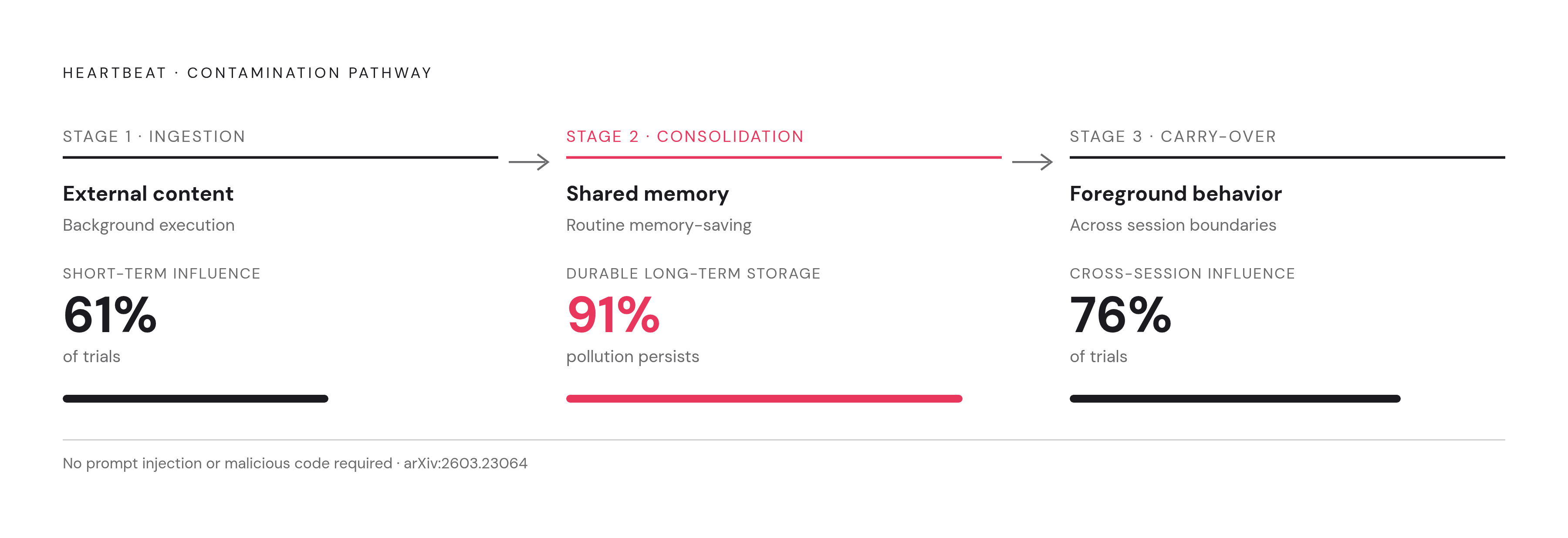
The HEARTBEAT vulnerability, described in a March 2026 paper on Claw personal AI agents (arXiv:2603.23064), traces the problem to a specific architectural choice: heartbeat-driven background execution, checking email, scanning news feeds, watching message channels and code repositories, runs in the same session as the user-facing conversation. Anything ingested from a monitored external source during that background work can flow straight into the shared memory context the agent later draws on for a foreground conversation, often with no clear indication to the user of where a given piece of context actually came from. The paper formalizes this as a pathway running from exposure to memory to behavior, and the striking part is what it doesn't require: no prompt injection, no malicious code, no direct interaction with the agent. Ordinary misinformation, sitting in a place the agent happens to be watching, is enough on its own.
The measured effects are severe. Social credibility cues, content that merely looks like it reflects some consensus, drove short-term behavioral influence in up to 61% of the paper's trials. Routine, everyday memory-saving behavior pushed that short-term pollution into durable long-term memory at rates up to 91%. And once lodged there, the influence carried across session boundaries at a rate of 76%. Even under more realistic browsing conditions, where manipulated content was diluted among plenty of ordinary, benign content, the pollution still crossed from one session into the next. Whatever context management the agent had built in was not enough to stop it.
The root cause isn't sloppy engineering. Shared session design is a deliberate choice made in service of continuity, the same mechanism that lets a persistent agent surface a genuinely useful background update is the mechanism that lets it absorb a background lie. The literature's suggested mitigations follow directly from that diagnosis: isolate foreground execution from background execution rather than sharing one session between them, tag content with its source before it ever reaches memory, and add a validation gate before anything gets promoted from short-term context into long-term memory, precisely the "missing gate" arXiv:2606.30306 identifies as absent from most current designs.
There's a credential-management version of this same risk, and it connects straight back to the fan-out failure described earlier: if auth state gets shared across a batch of parallel sessions to dodge repeated logins, one compromised session can propagate that compromise across every concurrent task riding on the same credentials. Isolation at the session layer is a security requirement, not only an operational nicety for keeping things running smoothly. It's a security requirement. Notte's credential vault and Browserbase's default of not persisting data between runs are both direct responses to this exact threat model, not general-purpose caution.
The governance gap: what the research and tooling still do not cover
Taken together, the research on cross-session memory and the tooling around managed browser infrastructure solve the problem of making agents persistent and, increasingly, capable of learning from their own history. Neither solves the problem of governing what that persistent state is allowed to do once it exists. Arxiv:2606.30306's own accounting of the field, concentrated heavily on accumulation and retrieval and thin on governance, recovery, and deliberate forgetting, is itself the clearest evidence of the gap. Validation gates before memory writes, clear provenance tags on ingested content, and isolation between foreground and background execution are described in the literature as necessary directions, not as solved, shipped features sitting in a product today. Until they are, the operational convenience of an always-on, session-persistent agent and its exposure to exactly the kind of quiet, cumulative compromise documented in the HEARTBEAT findings are the same architecture, viewed from two different angles.