Headless Browser Selection for Production AI Agents
Reliability through infrastructure matters more than picking between browser automation frameworks.
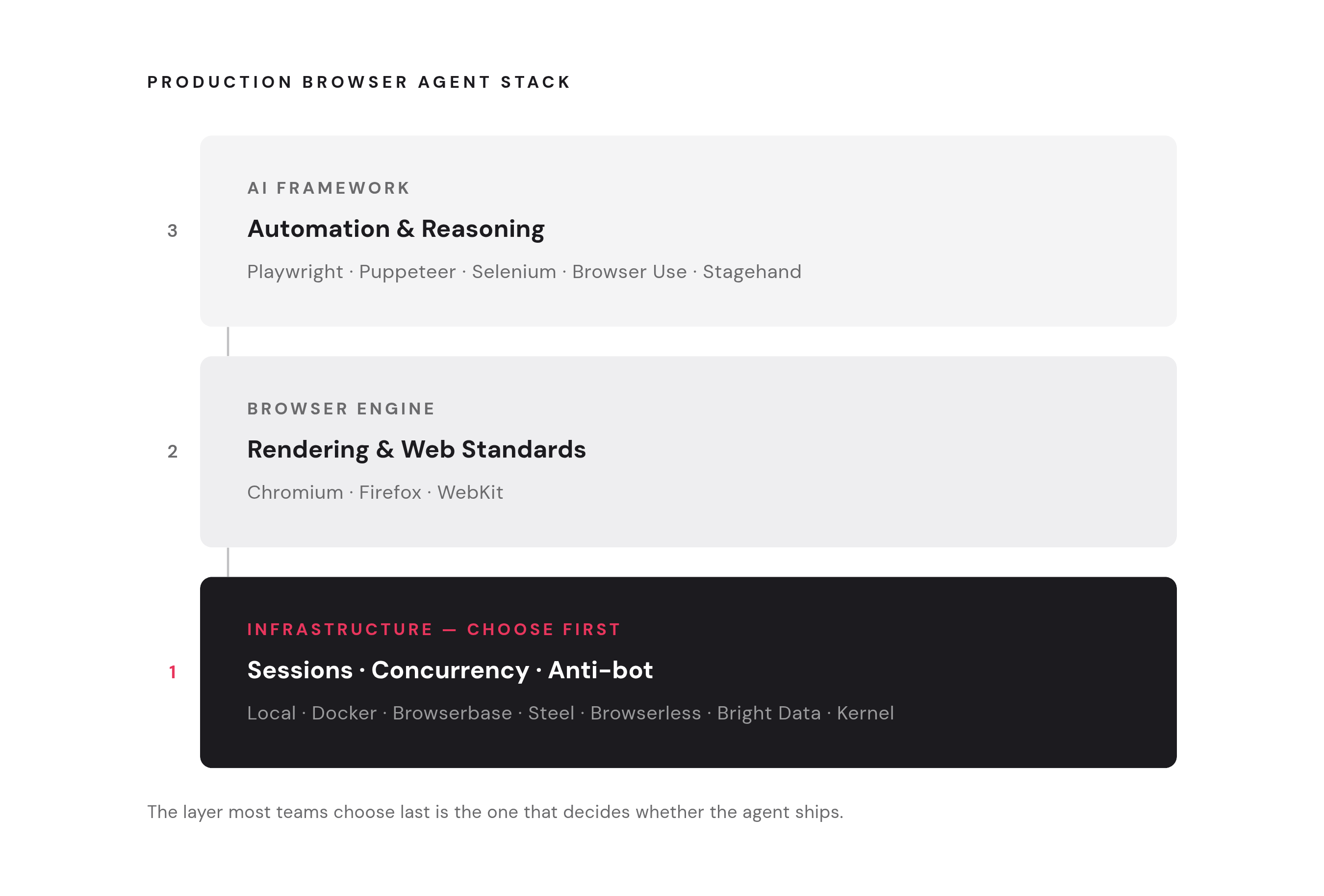
The three-layer stack: browser engine, automation framework, and infrastructure
The choice of headless browser for a production AI agent is a reliability decision, not a feature comparison. Most teams get the order of operations backwards: they pick a framework first and treat infrastructure as an afterthought, then discover the mistake three weeks in, when the agent that logged into a client portal flawlessly on Tuesday returns nothing on Friday because a session token expired or a fingerprint check flagged the request. What matters is whether a given tool, at a given layer of the stack, survives contact with authenticated sessions, anti-bot defenses, and concurrency, not Playwright versus Puppeteer. It's whether a given tool, at a given layer of the stack, survives contact with authenticated sessions, anti-bot defenses, and concurrency, because those three conditions separate a working demo from a system that survives its first month in production.
Most writeups collapse three distinct engineering decisions into one comparison table, and that collapse is how teams end up buying the wrong tool for the problem they actually have.
Layer one is the browser engine itself: Chromium, Firefox, or WebKit. This determines how a page renders and which web standards get respected. It has nothing to do with developer experience. It's a rendering and compatibility question, full stop.
Layer two is the automation library or AI framework, the code that actually drives the engine. This is where the real branching happens. Deterministic scripts issue exact commands (click this selector, wait for that class name). AI-native frameworks describe an outcome and let a model figure out the steps. Most production agents in 2026 run some hybrid of the two, and which hybrid a team needs depends on how unpredictable the target pages are.
Layer three is infrastructure: where the sessions actually run, on a local machine, a self-hosted Docker container, or a managed cloud service. This layer decides whether the agent can hold ten sessions or ten thousand, whether a login persists across a task interruption, and whether a Cloudflare challenge kills the run.
The history explains why the field looks the way it does. Selenium showed up in 2004 for automated browser testing, built around a human writing explicit test steps. Puppeteer and Playwright came later, giving developers more direct programmatic control over the browser. RPA platforms layered explicit, rule-based instructions on top of that. Browser agents are the next step in that lineage: instead of scripting "click button with id=submit-form," a developer or an agent framework now says "submit the form," and the underlying model resolves that into an action against whatever the page actually renders.
A team whose agents keep failing because sessions drop or IPs get banned does not have a framework problem. It has an infrastructure problem, and no amount of switching between Playwright and Puppeteer fixes that. Evaluate infrastructure first, every time. Everything above it is comparatively easy to swap later, and teams that get this order backwards end up rebuilding the same agent twice.
Playwright, Puppeteer, and Selenium at the automation library layer: what each one is for in 2026
Playwright is the right default for anything starting fresh, and there's little reason left to argue otherwise. Built by Microsoft, it drives Chromium, WebKit, and Firefox through one API, so a script written once runs against three rendering engines without a rewrite. Its auto-wait behavior, which pauses for an element to actually be present and interactable before acting on it, eliminates a large share of the flaky, timing-based failures that plague browser automation. Its isolated browser contexts let multiple agent sessions, each with its own cookies and storage, run independently, which matters once an agent needs to run parallel jobs. Its tooling is designed to minimize dependency friction, so there's no dependency mismatch to chase down late at night. One real caveat: its API surface is large, and when an LLM gets asked to generate Playwright code from scratch, a broad, unscoped set of documentation in the prompt context tends to produce sloppier output than a narrower, task-specific reference would.
Puppeteer earns its place only when the workload is explicitly tied to a single specific browser. Treating it as a general-purpose alternative to Playwright misreads what it's for. Maintained by the Chrome team itself, it talks to the browser through the Chrome DevTools Protocol directly, which makes it the sharper tool for performance profiling, low-level network interception, or PDF and screenshot generation where Chrome's specific rendering behavior is the point, not an inconvenience. Firefox support remains experimental, and there's no WebKit path. It isn't the wrong choice, but it's a narrower one, justified only when the target really is Chromium and nothing else.
Selenium belongs to the enterprise QA teams that already built on it. Starting a new agent project on it in 2026 is hard to defend. Twenty-two years of tooling, wide language support, and deep institutional investment keep it alive in large organizations with legacy test suites, but measured against Playwright's auto-wait, multi-context sessions, and single-install setup, Selenium's advantages for greenfield work amount to inertia, not capability.
None of these three libraries reason about a page. They drive it. What happens when a model gets layered on top, deciding what to click rather than being told, is a separate question.
The four AI-native frameworks and their distinguishing features at the reasoning layer
These frameworks typically sit on top of a library like Playwright. Choosing between them comes down to how much interpretive authority to hand the model, and under what conditions that authority pays off instead of introducing noise.
Browser Use is the leading open-source framework for AI browser agents, and the numbers back that up: an 89.1% success rate on WebVoyager, a benchmark covering 586 diverse web tasks, against OpenAI's own reported figure of 87% on the same test. It has passed 97,000 GitHub stars. It's model-agnostic: a developer picks and pays for whichever LLM API fits the budget, with no vendor lock on the reasoning layer, and running tasks through it costs a fraction of what closed commercial agents charge monthly. The tradeoff is that nothing underneath it is managed: anti-bot handling, session persistence, and scaling are entirely the developer's problem, which is exactly the infrastructure gap the later sections cover.
Stagehand, built by Browserbase, takes a hybrid approach through four primitives: act, observe, extract, and agent. Not every action on a page needs a model's judgment. A login button that never moves gets clicked deterministically. A product page with a layout that shifts by region or by A/B test benefits from a model actually looking at the structure before deciding what to do. Stagehand ships in TypeScript and Python, has roughly 24,000 GitHub stars, and pulls substantial weekly downloads. Its Model Context Protocol integration supports multiple models, with Claude among those supported in Browserbase's own tooling. It fits TypeScript-first teams who want code-level control but need room for a model to adapt when the page won't hold still.
Vercel's Agent Browser takes a different shape entirely: a CLI-first tool built for wiring browser control directly into AI coding assistants. It's open-source, with a Rust CLI and a Node.js fallback. GitHub star counts vary by source and date, reported as 12,100 in one place and 39,800 as of August 2026 in another, a gap that likely reflects nothing more than when each snapshot was taken. Its most distinctive feature is a snapshot system that assigns short reference IDs, like @e1 or @e2, to page elements, so the agent selects a target deterministically instead of relying on CSS selectors or XPath that can shift under it. Output comes back as structured JSON built for LLM parsing, and it connects over MCP to Claude Code, Cursor, Codex, and other AI coding assistants. It's built for an AI coding assistant issuing commands from the terminal.
Skyvern goes after a different user entirely: someone filling out forms and running multi-step workflows without writing a line of selector code. It scores 85.85% on WebVoyager and carries around 20,000 to 22,000 GitHub stars as of mid-2026. It's the most accessible of the four for non-developers running operations-heavy workflows, but its CAPTCHA and anti-bot handling is limited, which rules it out for anything where a target site is actively defending itself. It also carries an AGPL-3.0 license, and the network-use provision in that license deserves a legal review before it gets embedded in anything commercial.
The conditions that kill agents in production
Running a single browser instance on a laptop is trivial. Running a thousand of them, reliably, with sessions that survive an interruption and don't trip a bot detector, is a different engineering problem altogether, and it's the one most teams discover only after they've already shipped something that worked fine in the demo.
Four failure modes recur constantly in production, appearing in real deployments rather than in a framework comparison chart. Resource exhaustion comes first: a single Chromium instance eats a meaningful chunk of RAM, and spinning up several in parallel inside a standard container is a fast way to crash the host. Neither the automation library nor the AI framework touches this problem; it belongs entirely to infrastructure. Anti-bot defense comes second, in the form of CAPTCHAs, IP bans, Cloudflare challenges, and fingerprint detection. An agent that trips one of these doesn't degrade gracefully. It returns nothing, and this is where most demos quietly fail to become production systems.
Session state loss comes third. Authenticated sessions, cookies, and local storage need to persist across tasks and across interruptions, and an agent that loses its login state on a gated site often fails silently rather than throwing a clear error. Concurrency at scale comes fourth: managing thousands of simultaneous sessions, with retries and fault tolerance built in, is not something a local setup or a single Docker container was ever designed to handle.
A blocked agent and a logged-out agent return the same thing: nothing. Unblocking and session persistence are preconditions for the agent producing any output, not nice-to-haves sitting alongside the framework choice. They're preconditions for the agent producing any output. Pairing a brilliant AI framework with broken infrastructure produces the same result as pairing a mediocre framework with broken infrastructure: zero, every time. Infrastructure gets settled before framework features even enter the conversation, and teams that skip this step tend to walk the same path anyway: run Playwright on their own virtual machines, hit a concurrency wall under real load, bolt on retry logic by hand, then migrate to managed infrastructure eventually, just later and more expensively than if they'd started there.
Managed cloud browser infrastructure: five platforms and the tradeoffs that separate them
These platforms are not interchangeable, and each one is built around a different bet about what matters most. Picking between them means figuring out which failure mode from the previous section actually threatens a given workload, then buying for that, not for whichever platform has the longest feature list.
Browserbase leads on developer experience and pairs natively with Stagehand. It raised a $40 million Series B at a $300 million valuation. It works alongside Playwright and Puppeteer, so developers keep writing familiar automation code while Browserbase handles the browser lifecycle, scaling, and concurrency underneath it. Persistent sessions come with replay, and a "Session Live View" feature lets a developer inspect what an agent did after the fact. Pricing as of August 2026 starts free (1 browser hour, 3 concurrent browsers), then moves to $20 a month for Developer, $99 a month for Startup, and custom pricing at the Scale tier. It's cloud-only, with no on-prem package, though enterprise customers can arrange private cloud, VPC, and data residency terms. Teams under a contractual requirement to self-host should look at Steel or Browserless instead.
Steel is the open-source, self-hostable option, and it makes no assumptions about which agent framework sits above it. It's a headless browser API built for AI agents, controllable through its own API or through Python and Node SDKs. Its GitHub following trails Browser Use or Stagehand's, worth weighing against long-term community support. Its appeal is direct: full control, no framework lock-in, and the option to run it entirely on infrastructure the team already owns.
Browserless is a well-established option in the group and stays framework-agnostic across Playwright, Puppeteer, REST, and GraphQL. It deploys as managed cloud, self-hosted Docker, or dedicated private cloud, and it bundles authenticated browser profiles, session management, proxy support, CAPTCHA solving, session recordings, and live debugging. It targets high availability in its managed deployments. Because it stays on standard CDP rather than a proprietary layer, switching away from it later means changing a URL, not rewriting agent logic, a meaningfully lower switching cost than most alternatives offer.
Bright Data's Scraping Browser is built for one specific fight: sites that actively try to block automated traffic. It handles CAPTCHA solving, fingerprint rotation, and retry logic at the infrastructure level, running across Bright Data's network, and it is built for high-volume concurrent sessions. It works with standard Playwright and Puppeteer code, so teams keep their existing scripts and offload the anti-detection work elsewhere. It earns its cost when the target is hostile, and it's overkill for an agent working against cooperative internal systems that aren't trying to stop it.
Kernel takes a speed-and-agnosticism bet. The structural cause is that it's pure infrastructure, designed to sit underneath LangGraph, CrewAI, Browser Use, Mastra, or a custom stack without forcing a rewrite of agent logic. Its sandboxed cloud browsers spin up in under 30 milliseconds, and bot-handling is built into the infrastructure layer itself, not bolted on after the fact. For a team that already has an agent framework it likes and just needs fast, reliable, unblocked sessions underneath it, Kernel slots in without disruption.
None of these five platforms is a universal answer, and treating the choice as a popularity contest misses the point of the exercise. The decision comes down to which of the four production failure modes, resource limits, anti-bot defenses, session persistence, or raw concurrency, actually threatens a given agent. The infrastructure layer, more than any framework or library sitting on top of it, decides whether that agent ships and stays shipped.