Error Recovery and Retry Logic in Autonomous Web Agent Tasks
Building resilience into autonomous agents through layered error handling and retry strategies.
- Written by
- Danielle Osei-Bonsu
- Published
- October 27, 2026
- Reading time
- 8 min read
- Sources cited
- 5 sources ↓
What this covers
Error recovery and retry logic decide whether an autonomous web agent can finish real work when its tools, plans, or processes fail. Reliability comes from a deliberate escalation sequence. Each layer must recognize which failures it can handle, preserve the information needed for recovery, and hand control onward when another response is required.
Why autonomous web agents fail in production more than in demos
A demo can complete a clean sequence of actions, while production exposes an agent to failures across hundreds of tool calls. Every external action has its own probability of failure, and those probabilities compound across a multi-step task. Model weakness is not the only cause. Failures in data-fetching and tool-execution often happen before reasoning starts, so the model cannot fix a break it never sees.
Cemri et al.’s 2025 MAST taxonomy, built across Berkeley and Stanford from traces of seven multi-agent frameworks, describes fourteen failure modes. Its three categories are System Design Issues, Inter-Agent Misalignment, and Task Verification, and system design has the largest share. The study gives benchmark failure rates of 41–86.7% for state-of-the-art open-source multi-agent systems, mostly because of flaws in how the systems are designed. Step Repetition, in which agents redo work they have already done without getting further, is one of the most common failure sub-types.
But some failures leave no clear tool error. Context compaction can drop safety constraints without warning, so an agent can break earlier instructions while believing it is right. Every API call may return 200 OK. This “confidence failure” separates successful execution from successful work, showing why diagnosis must extend beyond transport errors.
Classifying the error before deciding what to do about it
The first recovery decision concerns the kind of failure. A transient error, such as a timeout, rate limit, or temporary network failure, may resolve on another attempt. A permanent error, including bad input, a missing resource, a hallucinated tool name, or a schema mismatch, requires a different action. A critical error involving a budget overrun, destructive side effect, or irreversible action requires state preservation and human escalation. These classes lead to different handling paths.
The practical test is whether repeating the action could reasonably change the result and whether another attempt is safe. A malformed tool call that stays the same cannot fix its own input. Treating it as transient produces a retry storm that consumes API credits and exhausts the task budget without progress. Classification therefore controls both recovery and spending.
WebOperator demonstrates how this decision can begin before execution by filtering invalid actions. It also routes invalid-page errors, such as 404 responses, to predefined recovery actions including go_back or tab_close. The MAST taxonomy supplies a broader diagnostic vocabulary for multi-agent systems, but it does not prescribe recovery. Engineers must choose a response that fits the failure mode they have found and the circumstances in which it happened.
Retry logic for transient errors: backoff, jitter, and idempotency
For a failure classified as transient, exponential backoff gives the dependency time to recover. The wait doubles after each failed attempt, progressing through 1 s, 2 s, 4 s, and 8 s. Immediate repetition does the opposite. It sends more work toward a service precisely when that service is struggling to respond.
Backoff alone does not prevent synchronized retries. Agents that fail together can wait for the same interval and then hit the shared API together again. Random jitter spreads those attempts out over time, reducing the load spikes that come when they happen together. The retry budget must also have a limit, because 503s that keep coming can point to a lasting failure. Reaching the attempt limit ends repetition and routes the failure onward.
Retry safety also depends on what the operation does. Reads and fetches need different retry configurations from posts, submissions, and purchases because the latter can create another side effect with each attempt. Retrying a POST without an idempotency key can produce duplicates. Backoff controls timing, while idempotency guards the effect of repetition. Neither replaces the other, and an attempt limit cannot undo a duplicate action that has already committed.
Circuit breakers: stopping retry propagation before it cascades
A per-call retry budget limits one operation, but it does not protect a dependency from many agents making their own attempts. When the dependency is durably down, those attempts amplify the outage. Circuit breakers act above the retry layer. After a threshold of consecutive failures, a breaker opens and stops attempts for a holding period.
When that period ends, the breaker goes into a half-open state and lets one probe request through. A successful probe closes the breaker and restores normal flow. A failed probe resets the holding period. This separates testing for recovery from sending the full workload back to a service that may still be unavailable.
In multi-agent systems, the same protection belongs at agent boundaries and around external APIs. When an upstream agent fails durably, the downstream agent should receive a structured degraded-mode signal. Otherwise, a content agent can try to process CRON output that is missing, and then a chat notification agent can try to process content output that is missing. The failure cascades through the pipeline before anyone notices. A breaker at the boundary signals that the upstream agent is unavailable, so downstream work stops instead of going ahead as though it has a valid result.
Fallback chains for permanent failures: alternative paths when retry cannot help
A permanent error requires deciding which action should replace the failed action. The alternatives must be set out before the failure happens. An ordered fallback chain can route a failed primary API call to a secondary source or a degraded-but-available alternative. Malformed data can lead to another tool or a human-readable format path. The order is part of the design.
These alternatives must deal with the operation that failed, since moving the work elsewhere alone will not fix it. A missing page can call for backtracking or closing a tab, while an unsuccessful search can call for a different query. WebOperator’s predefined browser recovery actions illustrate this distinction. ToolMaze treats fault tolerance as a capability for evaluation, reinforcing that continuing through failure is distinct from performing well on an unobstructed task.
Agent-E demonstrates the planning-level version of this pattern. Its hierarchical planner can detect an overly narrow search query, discard the unsuccessful sub-plan, create a revised plan, and backtrack to a prior page for another attempt. Recovery becomes part of planning rather than a handler invoked only after execution collapses. However, selecting another route is not always enough, because the reasoning that selected the original route may itself need correction.
Self-correction and re-planning as the cognitive layer of recovery
Infrastructure recovery deals with tools that are unavailable, while cognitive recovery deals with a plan or output that is wrong. Repeating or rerouting a tool call cannot by itself repair the reasoning behind it. Shinn et al.’s Reflexion framework stores verbal self-critique in episodic memory and uses it to guide the next attempt after a failure. It reported gains on coding benchmarks when applied to GPT-4, improving on an 80% baseline score. ReAP applied reflection to web navigation and found larger gains on tasks the agent initially failed than overall.
Those results do not make reflection a universal remedy. Huang et al. show that intrinsic self-correction without external grounding often fails to improve results and can degrade them. The gains that studies report can depend on oracle signals or stronger prompts when feedback is given. The practical resolution is a hybrid approach that combines verbal reflection with test execution, tool-output validation, or post-execution checks.
External checks also address the confidence failures that infrastructure monitoring misses. Before a result is committed, lightweight validation can check for duplicates, reasonable counts, and hallucinated content. Reflection then has evidence to work from. Even with grounding, further rounds add cost and latency, while gains diminish. Two to three rounds can improve accuracy, but the useful stopping point depends on where returns flatten in the task domain.
Checkpointing and durable execution: recovering state across process failures
All the recovery mechanisms described so far assume that the agent process is still running. LangGraph checkpoints agent state, but an in-flight run executes within a single process. If that process dies, execution stops. A persistent checkpointer preserves the data, while something external must detect the failure, determine where to re-enter the graph, and restart it.
Temporal’s LangGraph integration entered public preview in July 2026 to address that execution gap. It provides automatic failure recovery, runs that survive crashes, and human-in-the-loop steps that can wait for extended periods at no cost. The recovery architecture must account for both the saved state and the mechanism that resumes work.
The 2026 Crab checkpoint/restore study found that most agent turns leave state unchanged in ways that matter for recovery, so checkpointing every turn costs more without enough benefit to match. Its semantics-aware approach raised recovery correctness from 8% for a chat-only baseline to 100%, while cutting checkpoint traffic by up to 87%. The production pattern is therefore selective checkpointing through a CheckpointSaver backed by PostgreSQL or Redis, with distributed tracing making resumption points observable and auditable. For long-running work, checkpointed subtasks reduce recovery cost. Re-anchoring the goal and constraints at each boundary also helps keep them from being lost through context compaction.
Human escalation and the limits of fully autonomous recovery
Critical failures should bypass routine recovery attempts because further autonomous action can deepen the damage. The required response is to save current state to the checkpoint store, emit a structured alert with enough context for a person to decide, and halt autonomous action until that decision arrives. Destructive or irreversible steps need review before they are committed, while someone can still step in to prevent the harm.
Escalation can also serve a narrow, recognizable condition. WebOperator opens a human-intervention path for captcha encounters. Durable execution makes that handoff independent of an immediate response. With Temporal, the agent can remain suspended at the escalation point and resume from saved state after the person responds.
The emerging operational pattern as of 2026 adds remediation agents that watch a primary agent’s trace spans, detect failure modes, and dispatch constrained sub-agents for recovery. This frees people from routine handling while keeping limits on what recovery agents can do. Genuinely critical or ambiguous failures still go to a human. A clear stopping rule makes autonomous action trustworthy because the system’s authority to proceed is bounded by its obligation to ask.
Putting the recovery ladder together as a system
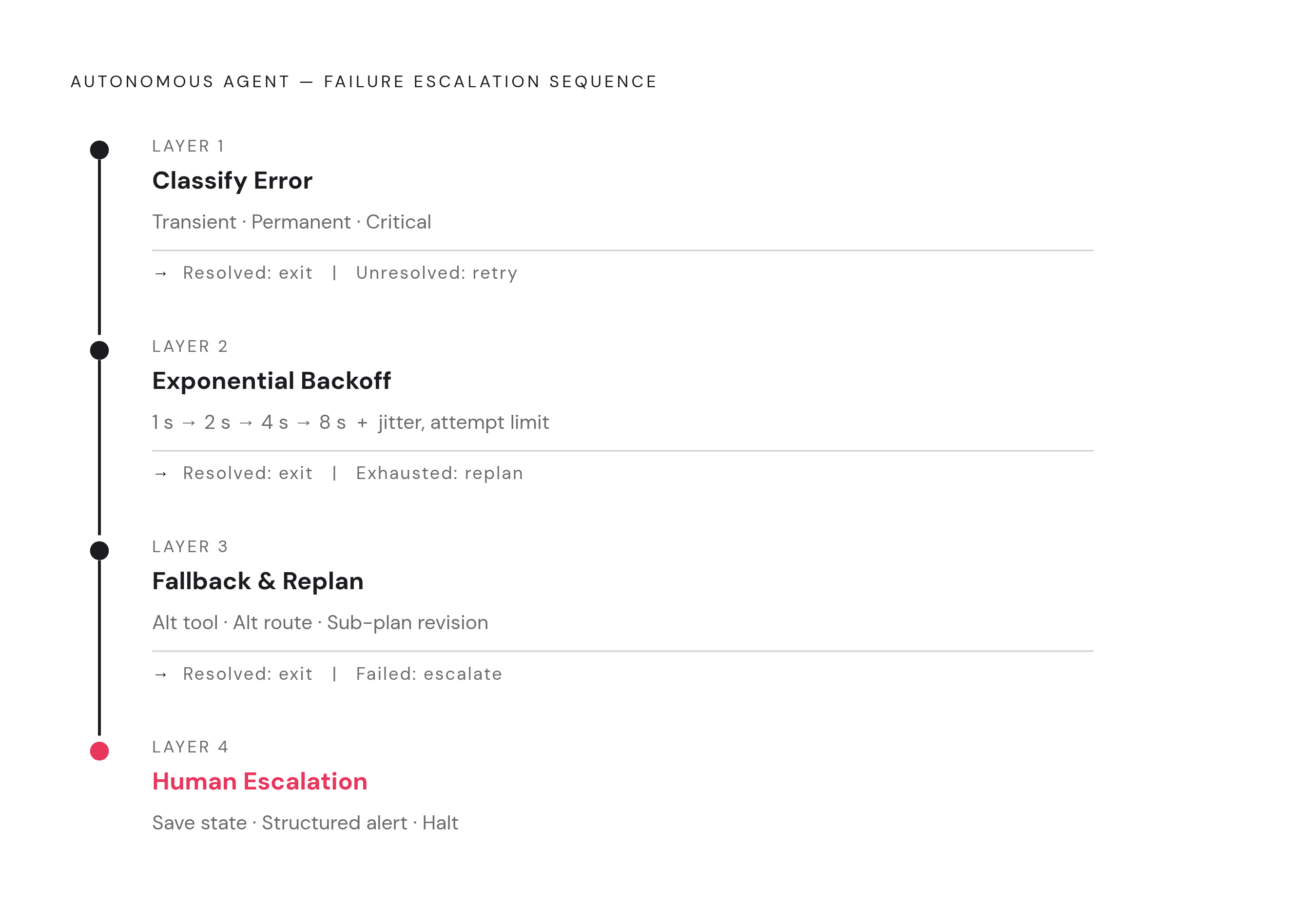
The recovery ladder is a conditional sequence that allows seeking help before exhausting every mechanism.
ToolMaze finds that as models grow, their fault tolerance improves far more slowly than how well they do basic tasks. A stronger model cannot substitute for these architectural responsibilities. Taskade’s agent platform provides a no-code path for classification-first handling, retry with backoff, fallback chains, and human escalation, reducing the need to implement those mechanisms from scratch.
The concrete test is whether an agent can lose its process mid-task and resume from a checkpoint, then discover that its primary tool returns invalid data. It must be able to use an alternate path and revise the failed plan using external evidence. If it still cannot finish safely, it must hand the task to a person with full context, without crashing or committing an invalid result without warning.
Methodology & sources
- EffGen: Enabling Small Language Models as Capable Autonomous Agents
Provided the 80% baseline score figure cited in the section on self-correction and reflection frameworks.
- Practical Limits of Autonomous Test Repair: A Multi-Agent Case Study with LLM-Driven Discovery and Self-Correction
Provided the recovery correctness figures showing improvement from 8% for a chat-only baseline to 100% with semantics-aware checkpointing, and the checkpoint traffic reduction figure.
- WebOperator: Action-Aware Tree Search for Autonomous Agents in Web Environment
Provided examples of pre-execution action filtering and predefined recovery actions such as go_back and tab_close for invalid-page errors.
- Agent-E: From Autonomous Web Navigation to Foundational Design Principles in Agentic Systems
Provided the Agent-E hierarchical planner example of detecting a failed sub-plan, revising it, and backtracking to a prior page as a planning-level recovery pattern.
- Model or Harness? An Interaction-Centric Taxonomy for Localizing Agent Failures
Provided the MAST taxonomy's fourteen failure modes, three categories, and benchmark failure rates of 41–86.7% for multi-agent systems, along with the Step Repetition failure sub-type.