Rate Limiting Patterns That Block AI Agent Pipelines
Standard rate limiters treat agent bursts like attacks, causing cascading failures.
- Written by
- Danielle Osei-Bonsu
- Published
- September 30, 2026
- Reading time
- 10 min read
- Sources cited
- 6 sources ↓
What this covers
Rate limiting, as a discipline, was built around a picture of a human sitting at a keyboard: a click, a pause, another click, all governed by reaction time and attention span. That picture no longer matches the traffic hitting most production APIs. A single agent task now triggers dozens of sequential calls in one uninterrupted burst, tool lookups, retrieval queries, reasoning steps, completions, each firing the moment the previous one returns. There's no pause built in, because there's no human waiting to read the response before typing the next thing.
To a standard rate limiter, that pattern doesn't look like a busy user. It looks like an attack. Nordic APIs has described agent traffic as arriving in bursty, unpredictable spikes that are functionally indistinguishable from a DDoS pattern, even when every one of those requests is legitimate and wanted. Worse, the request counter underneath most rate limiters treats a trivial call and an expensive one identically: a 50-token prompt and a 10,000-token prompt both increment the same counter by exactly one, despite the fact that their compute cost, latency, and provider billing can differ by orders of magnitude.
None of this stays a niche concern for long. The mismatch between how rate limiters count and what agents actually do is not an edge case at this scale; it is an infrastructure problem every team building on these APIs has to solve. Fast.io has gone as far as naming unmanaged rate limiting the single leading cause of agent failure in production environments, which is a strong claim, but the incidents below back it up. Gartner predicts that more than 30% of the increase in API demand will come from AI and tools using large language models (LLMs) by 2026, and a separate Gartner forecast puts 40% of enterprise apps with embedded AI agents by year-end 2026, up from less than 5% in 2025, and that scale of incoming agent traffic makes this mismatch an infrastructure crisis, not an edge case.
What runaway agents cost when nothing stops them
Start with the cleanest illustration on record. One autonomous agent got stuck in a retry loop and sent tens of thousands of requests over several hours, enough to bring down a client's own API, and at no point did it ever break the per-user limit of 60 requests per minute. The rate limit worked exactly as designed. The agent simply never stopped, which is the part volume-based controls have no way of catching: a system that only asks "is this too fast" has nothing to say about "is this ever going to end."
Cost incidents follow the same shape once you swap latency for dollars. Engineer Teja Kusireddy built a multi-agent research tool that slipped into a recursive loop and ran undetected for eleven days, racking up a $47,000 API bill before anyone noticed. Separately, a stolen Gemini API key accumulated more than $82,314 in charges in a short window, with no rate limit or spending cap anywhere in the path to stop it. A Claude Code sub-agent, in another documented case, entered an infinite loop and burned through an enormous volume of tokens in a matter of hours, with no stop mechanism a user could reach to intervene.
These aren't isolated horror stories traded around as cautionary folklore. By spring 2026, teams were reporting they had already blown 3x past their annual token budgets, a budgeting model built for human-paced usage colliding with a cost curve that doesn't behave the way anyone's spreadsheet assumed it would. That's a substantial miss in a forecast. That's a budgeting model built for human-paced usage colliding with a cost curve that doesn't behave the way anyone's spreadsheet assumed it would.
Context accumulation turning retry loops into exponential cost events
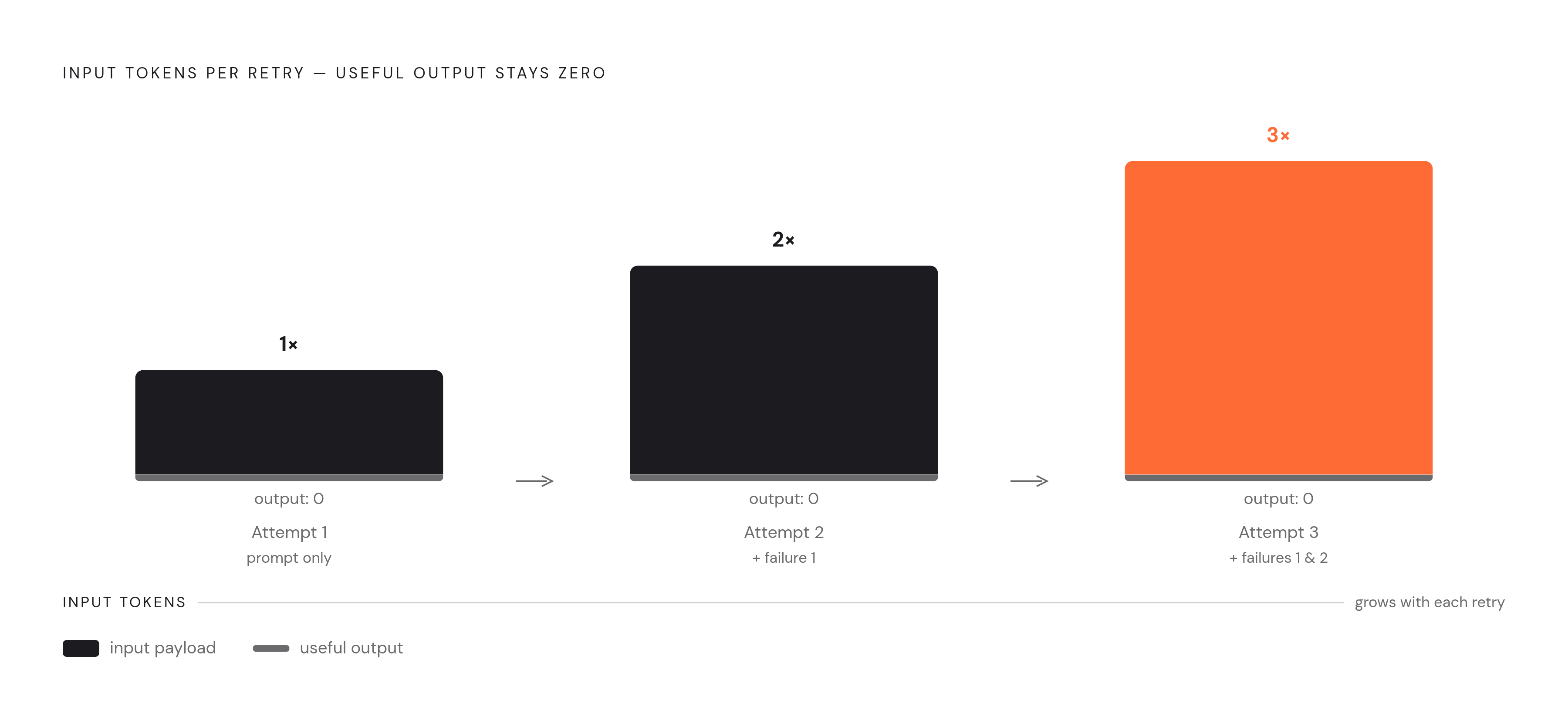
The mechanism behind those bills is clear once you see it laid out. The gap comes from how context works: every LLM call sends the full conversation history back in as input, so a large context costs the same number of input tokens on every subsequent request regardless of how much new content is added.
Running the arithmetic forward makes the shape obvious. A failed attempt gets appended to context. The next call now carries that failure plus the original prompt, so it costs more than the first attempt did, and it fails too, so it gets appended as well. Each retry doesn't just add a call, it adds a call that's more expensive than the one before it, because the input payload keeps growing while the output does not. At Claude Sonnet's input pricing, that per-step cost multiplication adds up fast, and across a team running many of these tasks per day over the course of a working month, the total can run into six figures. The failure mode here is an agent that returns a right-looking answer at a cost the model never had to justify. It's an agent that decides to retry, and in doing so, grows its own token load on a curve that has nothing to do with how much useful work is actually getting done.
Streaming adds a second, quieter blind spot to the same problem. A streaming call registers as one request against the counter the instant it starts, but the actual cost keeps accumulating for as long as the stream runs. A request-count limiter sees a single event and moves on, while the meter underneath keeps running invisibly until the stream closes. Per LeanOps production benchmarks, AI agents burn roughly 50x more tokens than single-turn chatbots on equivalent tasks.
The provider rate limit landscape agents operate inside
Whatever architecture a team builds internally, it eventually runs into ceilings the provider controls, and those ceilings aren't identical across vendors. Most major AI providers throttle on requests per minute and tokens per minute simultaneously, but the third constraint differs by provider: OpenAI adds daily caps on both requests and tokens (RPD and TPD), Google's Gemini enforces a daily request cap, and Anthropic splits token accounting into separate input and output limits (ITPM and OTPM) rather than one combined TPM figure, with no daily request cap at all. A pipeline built against one provider's shape and pointed at another's will get bottlenecked by whichever dimension it happens to hit first, and that dimension changes depending on the provider.
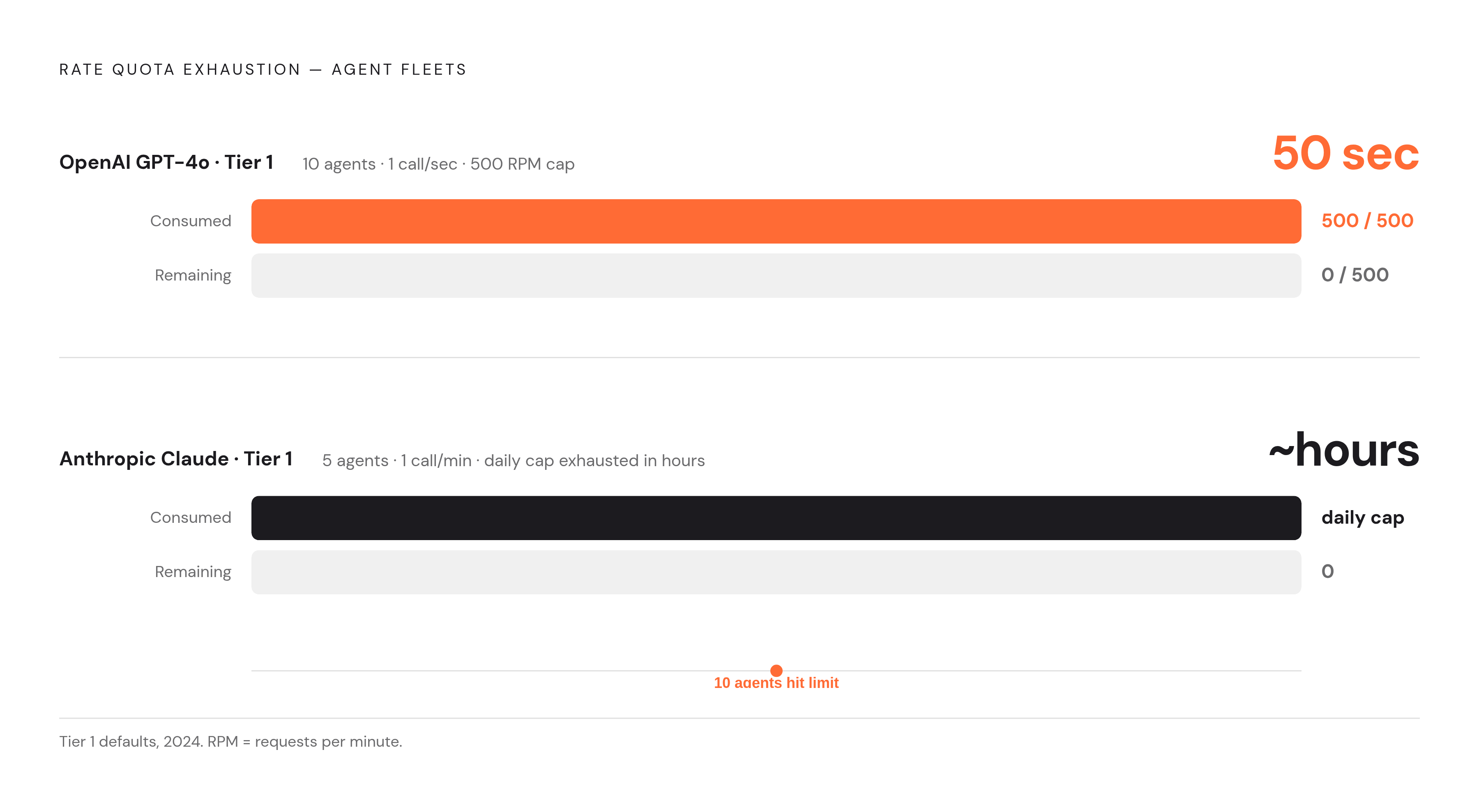
Anthropic's structure punishes low-tier accounts particularly hard. Tier 1 access comes with low RPM, a low daily request cap, and a tight per-minute input token allowance for Claude Opus specifically, while Tier 4 opens up into high RPM and high TPM. The daily cap is the trap most teams don't see coming: a fleet of just five agents, each making one call per minute, can exhaust a Tier 1 daily quota within hours, not days, which has led some to call Anthropic the most restrictive provider in the field, especially where Opus is concerned.
OpenAI's tiers move in the opposite direction, offering very high RPM and TPM ceilings at Tier 4, but getting there requires meaningful cumulative spend first. The same unit mismatch every provider shares produces this: rate limits are frequently denominated in tokens, not requests, so two 50-token calls and one 10,000-token call are wildly different workloads that a requests-per-minute counter will happily treat as the same thing. As a Tier 1 example of a modest RPM ceiling, a fleet of 10 parallel agents each making 1 GPT-4o call per second can exhaust OpenAI Tier 1's 500 RPM quota in 50 seconds, per openlegion.ai.
Six specific ways standard rate limiting patterns fail in agent pipelines
The thundering herd. Most agent frameworks respond to a 429 by retrying, and when ten agents hit the same limit at once, all ten get 429s at once. If each one waits a fixed one second and retries, they all retry at the same instant again, producing another synchronized burst of 429s that turns into a self-sustaining failure loop rather than a resolved one. The same herd effect resurfaces at window reset: every request that was queued or retrying against the old quota fires the moment the new window opens, producing a second synchronized spike against Redis and downstream systems at precisely the moment smooth, staggered traffic is what's needed.
The fixed-window boundary problem. A fixed window lets a consumer spend their entire budget in the last second of window N, then spend the entire next budget in the first second of window N+1, which doubles their effective rate at the seam between windows. For human traffic this barely registers, since no person is clicking fast enough to exploit a one-second seam. For an agent firing calls at machine speed, hitting both sides of that boundary isn't a rare fluke, it's routine behavior that happens on nearly every window rollover.
Coarse bucket keys. Per-IP limiting assumes each source of traffic has its own address, which breaks down completely when an entire fleet of agents runs from shared infrastructure and shows up as one IP to the limiter. Per-user limiting has the opposite problem: it's too broad, so one misbehaving agent script can exhaust a user's entire quota and lock out every other legitimate task that user is running, including the debugging work needed to find the rogue agent.
Shared key exhaustion. A single agent making 60 requests per minute against one API key sits comfortably inside most quotas. Ten agents behind that same key can all hit a rate limit simultaneously, each receiving a 429, which triggers retry logic in most agent frameworks.
Fan-out and unbounded sub-agent spawning. A single agent action, one retrieval call or one tool invocation, can spawn dozens of downstream model calls without any of them individually breaking a limit. No sub-agent in the chain ever exceeds its own cap; the aggregate fan-out exhausts the shared pool anyway and takes the whole pipeline down with it, because traditional rate limiters have no concept of a task-level or workflow-level budget, only a per-call or per-user one.
Missing or mishandled Retry-After. The instinctive response to a 429, retrying immediately, is exactly the wrong move: it wastes quota on calls that are going to fail anyway and can push the provider into stricter throttling as a penalty. Honoring the Retry-After header when the provider sends one is table stakes; the harder case is the provider that doesn't publish a window at all. One team solved that gap by treating it as a measurement problem: log the timestamp of the first 429, measure when the next successful call actually lands, and use that gap as the estimated window going forward, at the cost of one extra calibration request.
Architectural fixes that address each failure pattern directly
Switching from counting requests to counting tokens is the fix that resolves nearly everything above. Tracking total tokens, prompt plus completion, against a per-window budget instead of incrementing a counter by one for every HTTP call makes the accounting finally reflect what's actually being consumed. Most providers make this straightforward: OpenAI, for instance, returns usage figures like usage.total_tokens in the response body, so the limiter reads that number after each call and deducts it from the consumer's remaining allowance. The same logic extends past LLM APIs to any resource with variable per-call cost: compute units, GPU seconds, data transfer bytes.
That one change doesn't fix the thundering herd on its own, though. Exponential backoff, doubling the wait after each successive 429 up to a capped maximum, spreads retries out across time instead of letting them all land on the same second. Add jitter, a small random offset layered onto each wait, and agents that hit the same limit simultaneously stop retrying in lockstep, which is what actually breaks the synchronized-burst pattern rather than just delaying it. Honoring Retry-After when it's present, and falling back to empirical calibration when it isn't, rounds out the retry layer.
Coarse bucket keys and shared key exhaustion both trace back to the same design error: keying quota to the wrong identity. Keying the rate limit bucket to the individual agent, rather than to the user or the IP address behind it, means one rogue agent no longer takes down every other legitimate task that user is running. For fleets running many agents at once, that per-agent keying needs a shared source of truth behind it, typically a centralized store like Redis, so every agent in the fleet draws from one pool and can see what the others have already spent. The practical target is a ceiling set safely below whatever the provider's tier actually allows, paired with a concurrency semaphore that caps how many calls can be in flight simultaneously, starting small and raising it only once the behavior under load is understood.
Fan-out gets solved one level up, at the workflow level rather than the call level. A priority queue makes sure the tasks that matter get quota first when the shared pool is tight, so a burst of low-value sub-agent spawning can't starve the work that actually needs to finish. For multi-step agents specifically, the quota check has to happen before the workflow starts, not partway through it: if a task will require many API calls, the full budget needs to be confirmed available before the first one fires, because partial results from a quota-interrupted workflow waste more tokens than a clean pre-flight rejection. A clean rejection before the work begins wastes nothing. A quota-interrupted job halfway through a chain-of-thought expansion wastes everything it already spent getting there.
Methodology & sources
- AI Agent Rate Limiting Strategies & Best Practices | Fastio
Provided the claim that unmanaged rate limiting is the leading cause of agent failure in production, and the token-count figures illustrating the cost gap between small and large prompts.
- Rate Limiting AI Agent API Traffic: 5 Patterns That Work
Supplied the specific incident of an agent sending tens of thousands of requests over several hours without ever breaking a per-user per-minute limit.
- AI Agent Rate Limiting: Quota Control, Circuit Breakers, and Budget Caps | OpenLegion
Provided the specific example of 10 parallel agents exhausting OpenAI Tier 1's 500 RPM quota in 50 seconds.
- AI Agents Burn 50x More Tokens Than Chats | LeanOps
Provided the production benchmark that AI agents burn roughly 50x more tokens than single-turn chatbots on equivalent tasks.
- The token bill came due: how runaway agents blow your AI budget | TrustGate AI
Provided the data point that teams were reporting blowing 3x past their annual token budgets by spring 2026.
- Why AI Agents Fail in Production | Data Science Collective
Provided the documented case of engineer Teja Kusireddy's multi-agent research tool that ran undetected for eleven days and accumulated a $47,000 API bill.